
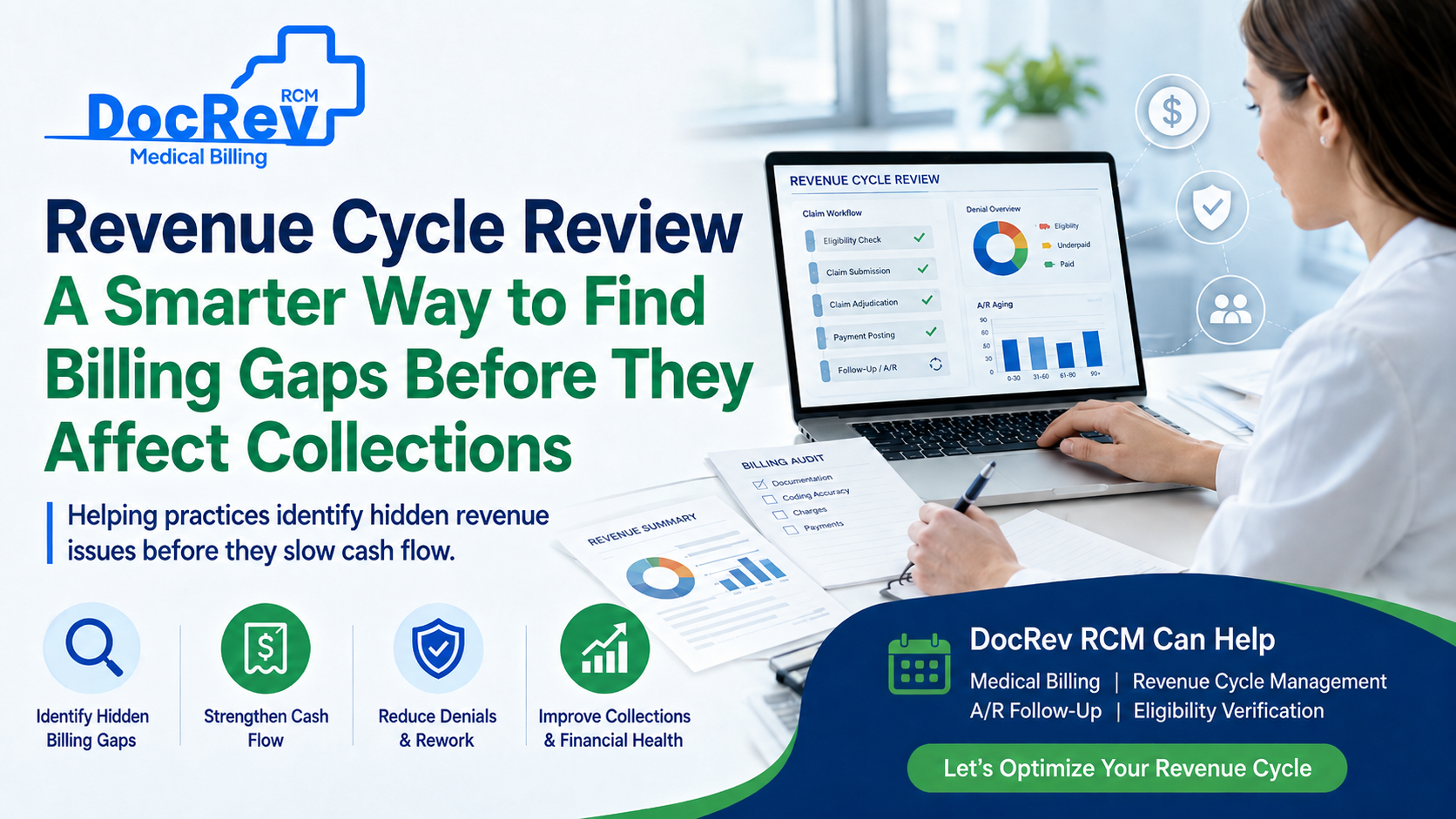
A medical practice can be busy every day and still have cash flow problems.
Patients are being seen. Claims are being created. Payments are coming in. Staff members are working hard. But somehow, collections still feel slower than they should.
That is usually the moment when a practice owner, administrator, or billing manager starts asking serious questions.
Are claims being submitted correctly? Is A/R getting too old? Are payments being posted the right way? Are underpaid claims being missed? Are eligibility issues creating delays? Is the billing team only fixing problems after they happen?
These are not small questions. They directly affect how much revenue a practice actually collects.
That is where a revenue cycle review becomes important.
A revenue cycle review looks at the full billing process, not just one claim or one denial. It helps identify where money is getting delayed, underpaid, written off, or left sitting in accounts receivable.
For many practices, this review becomes the first real step toward a cleaner and stronger billing operation.
At DocRev RCM, we help healthcare practices improve billing performance through medical billing services, revenue cycle management services, denial management, A/R follow-up, eligibility verification, credentialing, and specialty billing support.
In this blog, we will explain what a revenue cycle review is, when your medical billing process may need one, and how the right RCM partner can help turn billing confusion into a clear plan for better collections.
What Is a Revenue Cycle Review?
A revenue cycle review is a detailed look at how money moves through your medical practice.
It starts before the patient visit and continues until the final payment is collected.
In simple words, it checks whether your billing process is working properly from start to finish.
A proper review may look at patient registration, insurance eligibility, prior authorization, charge entry, coding, claim submission, claim rejections, denials, payment posting, underpayments, patient balances, old A/R, credentialing, and reporting.
This is why a revenue cycle review is more complete than only checking denied claims.
Denied claims are important, but they are only one part of the picture. Sometimes the real problem starts earlier, at the front desk. Sometimes it starts with eligibility. Sometimes it comes from coding. Sometimes it comes from payment posting or weak A/R follow-up.
A good revenue cycle review helps connect the dots.
It shows where the process is working, where it is breaking, and where the practice may be losing money without noticing it.
Why a Revenue Cycle Review Is Different From a Basic Billing Check
Many practices review billing only when something becomes urgent.
A payer delays payment. A claim gets denied. A patient receives the wrong balance. A provider asks why collections are low. A/R suddenly looks too high.
The problem with this approach is that it is reactive.
The practice only responds after the issue has already created stress.
A revenue cycle review is different because it looks for patterns before they become bigger problems.
For example, one denied claim may not seem serious. But if the same billing issue appears every week, that is a process problem.
One underpaid claim may be easy to miss. But if underpayments are not being reviewed at all, the practice may be losing revenue every month.
One eligibility mistake may look like a front desk error. But if eligibility checks are inconsistent, it can affect claim acceptance, patient balances, and collections.
That is why practices should not wait until revenue problems become obvious.
A revenue cycle review gives the practice a clearer view of the billing process before money gets stuck for too long.
Why Medical Practices Often Miss Billing Problems
Most billing problems are not loud.
They do not always appear as a big warning sign.
Many billing issues grow quietly in the background.
A few claims are submitted late. A few payments are posted without deeper review. A few billing issues are worked too slowly. A few patient balances are not transferred correctly. A few underpayments are accepted as normal. A few credentialing issues delay payments. A few A/R accounts get older every week.
Individually, these issues may not look dangerous.
Together, they can weaken the entire revenue cycle.
This is especially true for busy medical practices where staff members are already handling calls, patient questions, insurance updates, provider schedules, claim follow-up, and daily admin work.
When the team is overloaded, billing review often becomes secondary.
That is where outside medical billing audit services and RCM support can help. A fresh review can show what the internal team may not have time to catch.
9 Signs Your Medical Billing Process Needs a Revenue Cycle Review
A revenue cycle review is not only for practices in crisis.
It is also useful for practices that are growing, changing payers, adding providers, adding specialties, seeing more billing issues, or feeling unsure about collections.
Here are the signs your practice may need a closer look.
1. Collections Are Slower Than Expected
Slow collections are one of the clearest signs that something inside the billing process needs attention.
A practice may have good patient volume, but revenue still feels delayed.
This can happen when claims are not submitted quickly, claims are rejected before payer review, billing issues are not worked on time, payments are posted late, secondary claims are delayed, patient balances are not followed up, or A/R is not being managed properly.
Slow collections do not always mean the practice is not doing enough work.
Sometimes it means the revenue cycle does not have enough structure.
A revenue cycle review can help identify where the delay is happening. It can show whether the issue starts before the visit, during claim creation, after payer response, or during A/R follow-up.
This matters because every delay affects cash flow.
The faster your practice finds the bottleneck, the faster it can start fixing the problem.
2. A/R Is Growing Month After Month
Accounts receivable is one of the most important areas to review.
A/R shows money that has been billed but not collected yet.
Some A/R is normal. But when A/R keeps growing, especially older balances, it is a warning sign.
Old A/R may mean claims are not being followed up, payer responses are not being tracked, payment posting is delayed, secondary billing is not happening quickly, or patient balances are not being managed properly.
A/R can become a serious problem because older claims are harder to collect.
The longer a claim sits unpaid, the more difficult it becomes to resolve. Payer deadlines may pass. Documentation may be harder to find. Staff may lose track of the claim history. Patient balances may become harder to collect.
DocRev RCM’s account receivable services help practices follow up on unpaid claims and reduce aging balances before revenue gets stuck for too long.
3. Payment Posting Is Not Giving a Clear Picture
Payment posting is not just data entry.
It is one of the most important checkpoints in the billing process.
When payment posting is done correctly, your practice can see what the payer paid, what was adjusted, what is still owed, what should move to secondary insurance, and what needs follow-up.
When payment posting is weak, the entire billing picture becomes unclear.
A payment may come in, but the practice may not catch an underpayment. A payer response may appear on the remittance, but no one works it quickly. A patient balance may be moved incorrectly. An adjustment may be posted without proper review.
This can affect reporting, A/R, patient statements, and collections.
A revenue cycle review should always look at payment posting because this is where many hidden billing problems become visible.
4. Underpaid Claims Are Not Being Caught
Not every paid claim is correctly paid.
This is something many practices miss.
A payer may process a claim and issue payment, but the payment may be lower than expected. If the billing team does not compare payments against allowed amounts, contracted rates, or expected reimbursement, underpaid claims can slip through.
This is one of the most silent revenue problems.
The claim looks paid. No obvious rejection appears. The payment arrives. The claim may even be closed.
But if the amount is wrong and no one checks it, the practice may lose money without knowing it.
A revenue cycle review can help identify whether underpayments are being tracked and followed up properly.
For specialty practices, this is even more important because procedure-based claims, diagnostic services, and complex visits may involve higher reimbursement values.
5. Eligibility Issues Are Creating Billing Delays
Many billing problems start before the claim is even created.
If patient insurance is not verified properly before the visit, the practice may face avoidable delays later.
Eligibility issues can include inactive coverage, wrong payer information, missing secondary insurance, plan limitations, high deductible concerns, referral requirements, authorization requirements, or incorrect patient responsibility.
When these issues are missed, the claim may be delayed or moved into extra follow-up.
This creates more work for the billing team and more confusion for patients.
DocRev RCM’s eligibility verification services help practices confirm insurance details before care is billed, reducing avoidable problems later in the revenue cycle.
A revenue cycle review should check whether eligibility is verified consistently and whether front-end issues are causing downstream billing delays.
6. Coding and Documentation Do Not Always Match
Coding and documentation must tell the same story.
If the code submitted on the claim is not supported by the provider’s documentation, the claim may be delayed, underpaid, or flagged for review.
This does not always mean the provider delivered the wrong care.
Sometimes the service is correct, but the documentation does not clearly support the billed code.
Common issues include missing diagnosis support, incorrect modifier use, wrong CPT code selection, missing procedure details, missing medical necessity, incomplete notes, or documentation that does not match the claim.
This is where a medical coding audit can help.
A coding review can identify patterns before they become repeated billing problems or revenue loss.
For specialty practices, coding accuracy is especially important because many specialties deal with procedures, modifiers, bundled services, payer-specific rules, and detailed documentation requirements.
7. Credentialing Problems Are Delaying Payments
Credentialing problems can quietly stop revenue.
A provider may be seeing patients, but if payer enrollment is incomplete, outdated, or incorrect, claims may not pay properly.
Credentialing issues often happen when a new provider joins the practice, a provider changes location, a practice adds a payer, a group updates tax or billing information, CAQH is outdated, revalidation is missed, or enrollment applications are incomplete.
These issues can delay payments and create claim problems that are not always easy to fix quickly.
DocRev RCM supports provider credentialing and payer enrollment services to help practices stay ready to bill payers correctly.
A revenue cycle review should include credentialing and enrollment because billing cannot work smoothly if payer enrollment is not properly maintained.
8. Reports Show Numbers But Not the Real Problem
Many practices receive billing reports, but the reports do not always explain what is actually happening.
A report may show total charges, payments, adjustments, and A/R. But the practice still may not know why collections are slow, which payer is causing delays, which issue is repeating, which specialty service is underpaid, which provider has documentation gaps, which claims are aging fastest, or where staff time is being wasted.
Numbers alone are not enough.
The practice needs insight.
A revenue cycle review should turn billing data into clear action.
That means reviewing patterns, not just totals.
Good reporting should help a practice understand what needs to change next.
9. Your Team Is Busy, But Revenue Still Feels Unclear
This is one of the most common signs.
Your team may be working hard every day, but the revenue cycle still feels unclear.
This can happen when the billing process depends too much on manual work, scattered notes, payer calls, delayed follow-ups, or unclear ownership.
The practice may not know which claims need urgent attention. Staff may be fixing problems one by one without seeing the bigger pattern. Providers may feel frustrated because they are busy with patients but still unsure why collections are not stronger.
A revenue cycle review brings structure to this situation.
It helps separate activity from results.
Because being busy is not the same as having a healthy revenue cycle.
What Should Be Included in a Proper Revenue Cycle Review?
A strong revenue cycle review should not only look at one part of billing.
It should review the full process.
Patient Access and Eligibility
This includes checking whether patient demographics, insurance details, referrals, benefits, and eligibility are verified before the visit.
Front-end accuracy helps prevent downstream billing problems.
Prior Authorization
The review should check whether services that require authorization are being identified before the appointment and whether approval details are properly documented.
Charge Entry
Charge entry should be reviewed for missed charges, late charges, incorrect units, and incomplete service capture.
Coding and Documentation
A coding and documentation review checks whether the billed services are supported by the provider’s notes and whether codes, modifiers, and diagnosis links are being used correctly.
Claim Scrubbing and Submission
Claims should be checked before submission to reduce preventable rejections and avoidable payer delays.
Billing Issue Review
The review should identify recurring claim problems and show which issues are creating the most delay or follow-up work.
DocRev RCM’s denial management services help practices work denied claims and reduce repeat issues.
Payment Posting
Payment posting should be reviewed to confirm that payments, adjustments, secondary balances, and patient responsibility are posted accurately.
Underpayment Review
The review should check whether the practice is identifying payer underpayments and following up when payment does not match expected reimbursement.
A/R Follow-Up
A/R should be reviewed by age, payer, provider, claim type, and follow-up status. This helps identify where money is stuck.
Credentialing and Enrollment
Credentialing should be reviewed to make sure providers are active and correctly enrolled with payers.
Reporting
Reports should be reviewed to see whether they clearly show the problems that need action.
Why Specialty Practices Need a More Detailed Revenue Cycle Review
Specialty practices usually need a deeper review than general practices.
That is because specialty billing often includes more complex services, documentation rules, coding requirements, authorization needs, and payer policies.
DocRev RCM supports specialty medical billing services for practices such as pulmonology, nephrology, cardiology, internal medicine, urgent care, family practice, behavioral health, wound care, ENT, and more.
Specialty practices may need a detailed revenue cycle review when they deal with procedure-based billing, high-value claims, recurring visits, prior authorizations, payer-specific rules, complex documentation, modifier use, hospital and office place-of-service differences, or repeated payer follow-up.
For example, a pulmonology practice may need stronger review around PFTs, bronchoscopy billing, sleep-related services, and medical necessity documentation.
A nephrology practice may need deeper review around recurring care, CKD visits, ESRD-related billing, payer policies, and A/R follow-up.
A wound care practice may need stronger documentation review, procedure billing review, and payer policy tracking.
This is why specialty billing should not be treated as basic claim submission.
It needs careful review and steady follow-up.
How a Revenue Cycle Review Helps Improve Collections
A revenue cycle review helps improve collections by showing the practice where money is getting stuck.
Instead of guessing, the practice can make decisions based on real billing patterns.
A good review can help identify which claims are delayed, which payer creates the most issues, which codes need review, which balances are aging, which payments may be underpaid, which front-end steps are weak, and which process changes can improve cash flow.
This gives the practice a clearer path forward.
The goal is not just to find mistakes.
The goal is to build a better billing process.
That is where healthcare revenue cycle management becomes valuable. It connects all billing steps into one organized system, from eligibility to final payment.
When Should a Practice Request a Revenue Cycle Review?
A practice should consider a revenue cycle review when billing feels unclear, collections slow down, A/R grows, or staff cannot explain why money is delayed.
A review is also useful when the practice is adding a new provider, opening a new location, adding a new specialty, changing billing companies, bringing billing in-house, outsourcing billing for the first time, seeing more payer issues, or preparing for growth.
Many practices wait too long.
They only ask for help when the problem has already become expensive.
A better approach is to review the revenue cycle before issues turn into long-term revenue loss.
How DocRev RCM Helps Practices Find and Fix Billing Gaps
DocRev RCM helps practices review and improve the billing process with practical RCM support.
The goal is not only to point out problems.
The goal is to help fix them.
Medical Billing Services
DocRev RCM provides medical billing services that support claim creation, charge entry, claim submission, rejection correction, payment posting, secondary billing, tertiary billing, patient balance follow-up, and billing workflow management.
Revenue Cycle Management Services
DocRev RCM’s revenue cycle management services help practices manage the full revenue process from eligibility to final collection.
This gives practices better control over claims, payments, A/R, and reporting.
Medical Billing Audit Services
DocRev RCM’s medical billing audit services help practices review billing gaps, coding issues, documentation concerns, payer patterns, A/R, payment posting, and revenue cycle performance.
Denial Management
DocRev RCM’s denial management services help practices review denied claims, identify root causes, correct errors, appeal when needed, and reduce repeat issues.
Accounts Receivable Management
DocRev RCM’s accounts receivable management services help practices follow up on unpaid claims, reduce aging balances, and keep revenue moving.
Eligibility Verification
DocRev RCM’s insurance eligibility verification services help practices confirm coverage details before services are billed, reducing avoidable front-end billing issues.
Credentialing and Enrollment
DocRev RCM’s credentialing and enrollment services help providers stay enrolled with payers and ready to bill correctly.
Specialty Billing Support
DocRev RCM also supports medical billing by specialty, helping practices with specialty-specific billing workflows, payer rules, coding concerns, and follow-up needs.
The Real Value of a Revenue Cycle Review
The real value of a revenue cycle review is clarity.
It helps a practice understand what is actually happening inside the billing process.
Without a review, the practice may only see symptoms.
Slow collections. Old A/R. Busy staff. Unclear reports. Repeated payer issues. Delayed payments.
With a review, the practice can start seeing causes.
Eligibility gaps. Coding mismatch. Payment posting errors. Underpaid claims. Credentialing delays. Weak follow-up. Reporting gaps.
Once the cause is clear, the practice can take action.
That is what makes a revenue cycle review so important.
It turns billing confusion into a practical plan.
Final Thoughts
Your medical billing process does not need to be completely broken before it deserves a review.
Sometimes the best time to review your revenue cycle is when things feel just a little unclear.
Collections are slower than expected. A/R is growing. Reports do not explain enough. Payments are being posted, but underpayments are not being reviewed. Claims are being submitted, but the practice does not know where delays are happening.
These are signs that your revenue cycle needs a closer look.
A strong revenue cycle review helps your practice find billing gaps before they become bigger problems. It can show where money is delayed, where claims are stuck, where payer issues repeat, and where the billing process needs better structure.
DocRev RCM helps healthcare practices improve billing performance through medical billing, revenue cycle management, medical billing audits, denial management, A/R follow-up, eligibility verification, credentialing, and specialty billing support.
If your practice is working hard but collections still feel unclear, it may be time to review the process behind the numbers.
Ready to Review Your Revenue Cycle?
DocRev RCM can help your practice identify billing gaps, reduce avoidable delays, improve follow-up, and build a cleaner revenue cycle process.
Visit DocRev RCM or request a consultation through the Contact Us page.
Let your team focus on patient care while DocRev RCM helps keep your billing process clear, organized, and moving toward better collections.
FAQs
1. What is a revenue cycle review?
A revenue cycle review is a detailed review of your medical billing process from patient registration and eligibility verification to claim submission, payment posting, A/R follow-up, and final payment collection.
2. Why does a medical practice need a revenue cycle review?
A medical practice may need a revenue cycle review when collections are slow, A/R is growing, payments are posted incorrectly, underpaid claims are missed, eligibility issues cause delays, or billing reports do not clearly explain revenue problems.
3. Is a revenue cycle review the same as a medical billing audit?
A revenue cycle review and medical billing audit are closely related, but a revenue cycle review usually looks at the full billing workflow. A medical billing audit may focus more deeply on coding, documentation, claims, compliance, and billing accuracy.
4. What should be included in a medical billing audit?
A medical billing audit should include eligibility verification, prior authorization, charge entry, coding, documentation, claim submission, billing issue review, payment posting, underpayment review, A/R follow-up, credentialing, and reporting.
5. How can a revenue cycle review improve collections?
A revenue cycle review can improve collections by identifying where claims are delayed, where A/R is aging, whether payments are posted correctly, whether underpayments are missed, and which workflow gaps are affecting cash flow.
6. What are common signs of weak revenue cycle management?
Common signs include slow collections, growing A/R, repeated billing errors, unclear reports, delayed payment posting, eligibility issues, credentialing problems, missed underpayments, and staff being too busy to manage follow-up properly.
7. Why is eligibility verification important in revenue cycle management?
Eligibility verification helps confirm insurance coverage before services are billed. This reduces avoidable claim issues, helps identify patient responsibility, and gives the practice better information before the billing process begins.
8. Why should specialty practices review their revenue cycle?
Specialty practices often deal with complex coding, procedure billing, payer-specific rules, prior authorizations, documentation requirements, and higher-value claims. A detailed revenue cycle review helps find specialty-specific billing gaps before they affect collections.
9. Does DocRev RCM provide medical billing audit services?
Yes. DocRev RCM provides medical billing audit services, revenue cycle management, denial management, A/R follow-up, eligibility verification, credentialing, and specialty billing support for healthcare practices.
10. How can I contact DocRev RCM for a revenue cycle review?
You can contact DocRev RCM by visiting the Contact Us page and requesting a consultation for your practice.