
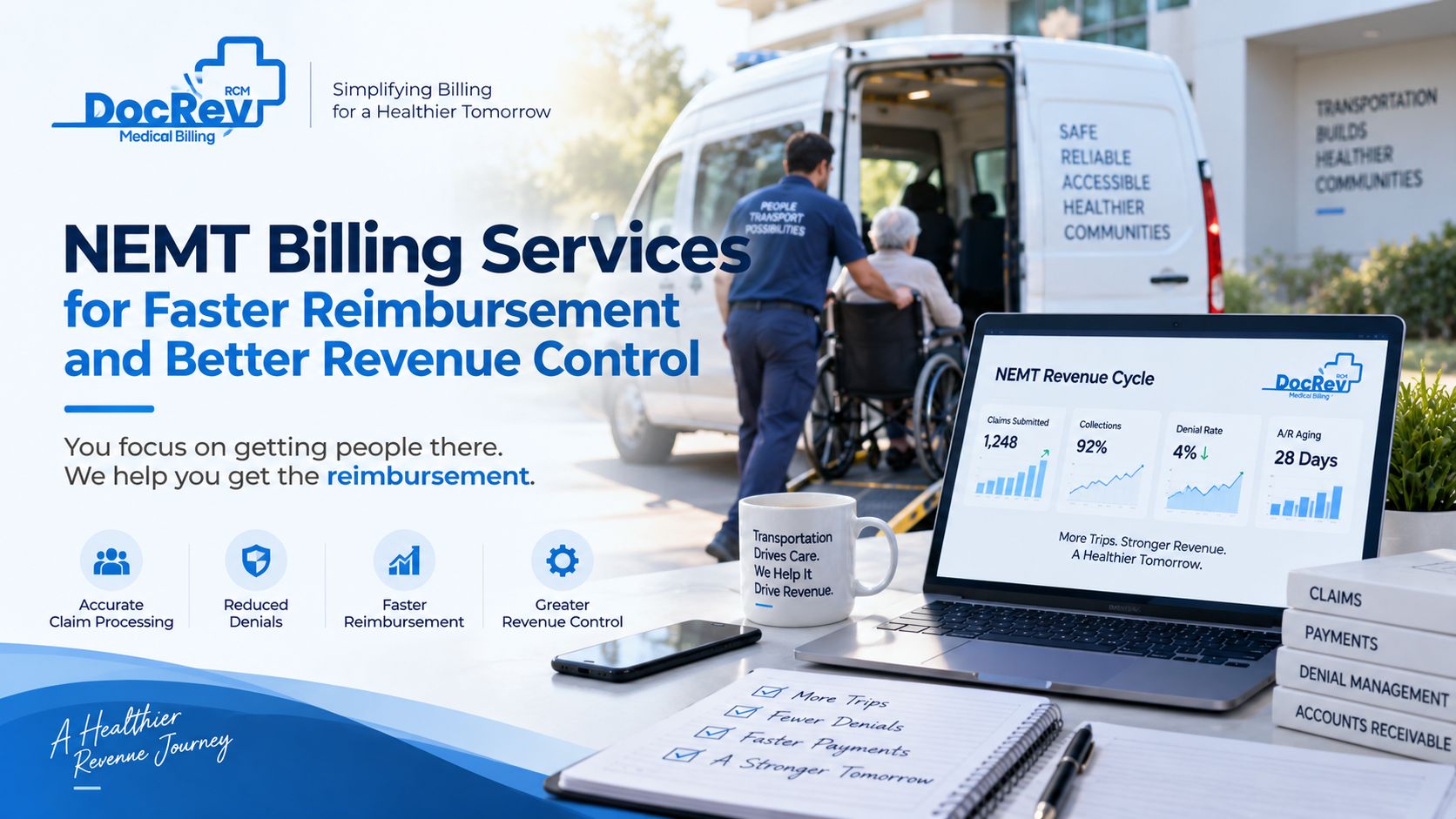
You completed the trip. The passenger reached the appointment. The driver finished the run. The trip was documented. Your team did its part. So why is the money still not in your account?
That is the frustrating part of running a non-emergency medical transportation business. A completed trip does not automatically mean a completed revenue cycle. Between the ride itself and the payment you expect, there can be eligibility questions, authorization requirements, documentation issues, billing errors, payer or broker requirements, claim rejections, denials, and unpaid accounts that require persistent follow-up.
For an NEMT operator managing multiple vehicles, drivers, routes, and daily trips, these problems can quietly become expensive. A few unresolved claims may not look serious on their own. But when billing issues repeat across hundreds or thousands of trips, the effect on cash flow can become significant.
That is why NEMT billing services should be viewed as more than a claim submission function. The real goal is to make sure completed transportation services move through the revenue cycle efficiently and that the revenue your company has earned does not remain stuck somewhere in the billing process.
DocRev RCM provides specialized NEMT billing support covering the billing workflow from claim preparation and submission through payment posting, denial management, and accounts receivable follow-up. Its NEMT service is specifically structured around transportation billing requirements such as trip documentation, eligibility, authorization, mileage, payer rules, and claim follow-up.
For an NEMT company, better billing is not simply about sending more claims. It is about getting the right claims out correctly, identifying problems early, following unpaid revenue consistently, and knowing where your money stands.
NEMT Billing Is a Revenue Problem, Not Just an Administrative Task
When billing is treated as paperwork, it is easy to underestimate its importance.
Your operation may be focused on dispatching vehicles, keeping drivers on schedule, serving passengers, maintaining vehicles, and managing daily transportation demands. Billing often happens somewhere behind all of that activity.
But financially, billing is where the work your company has already completed has to become revenue.
Every completed trip represents time, fuel, vehicle capacity, driver labor, and operational resources. If the resulting claim is delayed, rejected, denied, underpaid, or never followed up, the company has completed the service without fully realizing the financial value of that service.
That is why the question should not be, "Are we billing our trips?"
The better question is, "Are our completed trips consistently turning into collected revenue?"
That shift in thinking changes the entire approach to NEMT revenue cycle management.
A strong process connects the trip record to the billing process and continues following the claim until the financial outcome is understood. DocRev RCM's NEMT service similarly positions the billing process around charge and claim review, submission, payment posting, denial management, and accounts receivable follow-up rather than stopping at claim submission.
For an NEMT operator, the real value is making sure the financial process receives the same attention as the transportation operation itself.
The Difference Between Completing a Trip and Collecting the Revenue
From an operational perspective, a trip is complete when the passenger has been transported and the run has been closed.
From a financial perspective, the trip is not complete until the billing information has been processed and the expected reimbursement has been received or the account has been appropriately resolved.
That difference is easy to overlook.
Imagine an NEMT company completes 1,000 trips in a month. The operation may consider those 1,000 trips successful because the transportation was provided.
But what if some trips were never billed? What if others were rejected? What if some claims were denied? What if payments were received but several balances remain unresolved?
The company may have completed 1,000 trips but not converted all 1,000 into collected revenue.
This is where professional NEMT medical billing becomes valuable. The billing process should follow the trip beyond the point of submission and continue until the financial outcome is understood.
Eligibility and Authorization Need Attention Before Billing Becomes a Problem
One of the easiest ways to create a billing problem is to discover an eligibility or authorization issue after the transportation has already been provided.
NEMT programs can involve different payer arrangements, broker relationships, authorization requirements, and documentation expectations. The exact requirements can vary by program and state, which is why a billing workflow cannot rely on assumptions. Federal Medicaid resources recognize NEMT as an important benefit and note that states may administer the benefit through different delivery arrangements, including third-party brokers and managed care contracts.
For the transportation provider, that means the front end of the revenue cycle matters.
The billing team needs the information necessary to determine whether the trip is billable under the applicable arrangement and whether the documentation supports the service.
When these checks happen early, problems can be addressed before they become unpaid claims.
DocRev RCM's NEMT billing workflow includes eligibility verification and trip-level authorization as part of its specialized approach.
That is important because a billing team should not have to discover every problem after the claim has already been submitted.
Documentation Can Make or Break an NEMT Claim
Transportation documentation is more than a record that a vehicle moved from one location to another. It provides the information needed to support the service being billed.
The trip record needs to be consistent with the claim. Information such as the service provided, trip details, mileage, applicable authorization information, and other required documentation needs to be accurate and complete according to the applicable payer or program requirements.
When the trip record and billing information do not agree, the claim can become difficult to process.
This is where a strong NEMT billing process creates value. Instead of waiting for the payer to identify the problem, the billing team reviews the available information before submission and identifies discrepancies that can be corrected.
DocRev RCM specifically describes reviewing NEMT documentation, modifiers, payer policies, and mileage against trip records before claims are submitted.
The goal is simple: the claim should accurately represent the transportation service that was actually provided.
Mileage Accuracy Matters More Than Many Operators Realize
Mileage may seem like a small detail compared with the overall transportation operation, but it can directly affect the claim.
If mileage information in the billing record does not match the underlying trip documentation, the billing team may need to investigate and correct the discrepancy.
Repeated mileage problems can create additional work and may contribute to claim issues.
A better approach is to connect mileage documentation with the billing process before submission.
The billing team should have a clear process for reviewing the available trip information and identifying inconsistencies before they become payer problems.
For NEMT companies handling significant trip volume, this kind of review becomes even more valuable because manual errors can multiply quickly.
Clean Claims Help Keep Reimbursement Moving
A clean claim gives the payer the information it needs to process the service without avoidable corrections or clarification. That does not guarantee immediate payment because payers have their own processing rules and timelines.
But submitting incomplete or inaccurate claims creates unnecessary obstacles before the payer even has an opportunity to evaluate the service.
A professional NEMT billing process should therefore focus on claim quality before submission.
That means reviewing the available patient and payer information, trip details, authorization information, required documentation, coding or billing elements, and other applicable requirements.
DocRev RCM states that its NEMT billing specialists review claims against documentation and payer requirements before submission, with the goal of reducing avoidable rejections and keeping the revenue cycle moving.
For an NEMT company, that means fewer claims coming back for preventable reasons and less time spent correcting the same problems.
Denials Should Be Treated as Information, Not Just Problems
A denied claim is obviously a problem. But the denial itself can also tell you something about the billing process.
If the same denial reason appears repeatedly, there may be an issue upstream.
Perhaps information is missing from the trip record. Perhaps authorization is not being checked properly. Perhaps the claim is being submitted with inconsistent information. Perhaps a payer-specific requirement is not being handled correctly.
If the billing team simply corrects each claim individually without looking for the pattern, the same problem can continue indefinitely.
That is why effective NEMT denial management needs two connected objectives: recovering the revenue attached to existing denials and identifying the reasons those denials happened in the first place.
The recovery side may involve correcting, resubmitting, appealing, and following up when appropriate. The prevention side looks for recurring problems and improvements that can reduce future denials.
This approach turns denial data into something useful for the business.
Instead of asking only, "How many claims were denied?" the better question becomes, "Why were they denied, how much revenue is affected, and what can we change?"
A/R Is Where Unresolved Revenue Starts Becoming a Business Concern
Accounts receivable is often where billing problems become visible.
A claim that has not been paid remains an outstanding balance. As time passes, older accounts become more important to monitor.
For an NEMT company, the problem can grow quickly because transportation is often a high-volume operation.
One unpaid claim may not make much difference. Hundreds of unpaid claims can affect cash flow.
That is why A/R management should not be treated as something the billing team looks at only at the end of the month.
Outstanding claims need consistent attention.
The billing team should know what is unpaid, how old it is, why it has not been paid, what action has already been taken, and what needs to happen next.
DocRev RCM provides dedicated accounts receivable services for unpaid claims, aged A/R, and unresolved payer balances, which can be integrated with its NEMT billing support.
The objective is not simply to make an A/R report look better. It is to recover revenue that is legitimately owed to the transportation provider.
Your Billing Team Should Be Able to Tell You Where the Money Is
One of the most valuable things a professional billing operation can provide is visibility.
You should not have to guess how much has been billed. You should not have to guess how much remains unpaid. You should not have to guess why claims are being denied. You should not have to wait until the end of the month to discover that a recurring billing problem has been affecting your revenue.
Your billing information should help you understand the business.
For an NEMT operator, useful reporting should connect operational activity with financial performance. The exact reports depend on the company's payer mix, billing arrangement, systems, and scope of services, but the underlying objective remains the same: make it easier to understand what has been billed, what has been paid, what remains outstanding, and where attention is required.
DocRev RCM's NEMT service offering includes reporting around collections, denials, and A/R aging as part of its broader billing support.
That visibility becomes especially important as an NEMT company grows.
Why Growing NEMT Companies Outgrow Basic Billing Processes
A small transportation company may be able to manage billing with a simple workflow.
As the company grows, the same process may become difficult to maintain.
More vehicles mean more trips. More trips mean more billing records. More records mean more opportunities for missing information, inconsistencies, rejections, denials, payment discrepancies, and aging accounts.
At that point, adding more manual work is not always the answer.
The better approach is to build a billing process that can scale with the operation.
A growing NEMT company should be able to add transportation volume without creating a proportional increase in billing confusion.
That is one reason specialized NEMT revenue cycle management can be valuable. The billing process is designed around the realities of transportation rather than adapting a generic healthcare billing workflow to an NEMT operation.
What Specialized NEMT Billing Services Should Actually Handle
When an NEMT company evaluates a billing partner, it should look beyond the phrase "claims submission."
The important question is whether the service covers the areas that actually affect reimbursement.
A complete NEMT billing relationship can connect trip and charge review with eligibility, authorization, claim preparation, submission, payment posting, denial management, A/R follow-up, and reporting.
The exact scope should depend on the company's needs.
Some operators may need complete NEMT revenue cycle management. Others may already have an internal billing team and only need help with A/R or denials.
A good billing company should be able to understand the existing operation before recommending the service structure.
DocRev RCM states that its NEMT support can connect medical billing with eligibility verification, denial management, payment posting, credentialing, and accounts receivable support depending on the engagement.
That flexibility is important because not every transportation provider has the same billing problem.
Why General Medical Billing Experience Is Not Always Enough
There is a difference between having experience with medical billing and understanding NEMT billing.
NEMT billing has its own operational relationship between transportation records and reimbursement. Trip information, authorization, mileage, payer or broker requirements, and transportation-specific documentation can all affect whether a completed service becomes a successfully reimbursed claim.
A general medical biller may understand claims and insurance but still need to learn the operational details of NEMT.
That learning curve can create problems if the billing team does not understand how the transportation side and financial side connect.
Specialized NEMT medical billing is therefore not simply about knowing billing terminology. It is about understanding how a transportation operation creates the information that eventually becomes a claim.
That connection is what makes the billing process more effective.
The Cost of Leaving Billing Problems Unresolved
It is easy to think about billing problems only in terms of denied claims.
But the financial effect can be broader.
A delayed claim affects cash flow. A rejected claim creates additional work. An unresolved denial can become older A/R. An incorrect payment posting can make financial reporting less reliable. A recurring documentation problem can affect multiple claims. A weak follow-up process can allow otherwise collectible revenue to remain outstanding.
The cost is therefore not just the amount on one claim.
It can include staff time, delayed cash flow, administrative rework, missed follow-up opportunities, and revenue that becomes harder to recover as it ages.
That is why investing in better NEMT billing processes is not simply an administrative expense. It is part of protecting the financial side of the transportation operation.
A Better NEMT Billing Process Starts With the Trip
The strongest billing process does not begin when someone opens a claim. It begins with the information created around the trip.
When trip information is complete and organized, the billing team has a stronger foundation for preparing the claim.
When information is missing, inconsistent, or difficult to reconcile, the billing process becomes slower and more dependent on manual correction.
This is why NEMT billing should be connected to the operation rather than treated as a completely separate back-office task.
The goal is to create a clear path from completed trip to accurate documentation, billing review, clean claim, payer processing, payment, and reconciliation.
The fewer unnecessary gaps between those stages, the easier it becomes to maintain predictable reimbursement.
Why DocRev RCM Is Built Around the Complete NEMT Revenue Cycle
DocRev RCM's NEMT billing service is designed specifically around the financial challenges of non-emergency medical transportation.
The service combines NEMT-aware billing support with eligibility verification, claim submission, payment posting, denial management, and A/R follow-up. Its NEMT workflow also addresses transportation-specific areas such as trip documentation, authorization, mileage, modifiers, and payer requirements.
That matters because NEMT companies do not need another generic billing process.
They need a billing operation that understands the relationship between the transportation service and the reimbursement attached to that service.
DocRev RCM also states that its NEMT billing support is designed to work with both smaller and multi-location operations and provides reporting around collections, denials, and A/R aging.
The goal is straightforward: help NEMT operators spend less time dealing with unresolved billing problems and more time running their transportation operation.
When It Makes Sense to Consider Outside NEMT Billing Support
Not every NEMT company needs to outsource its entire billing operation.
But there are situations where outside support can make a meaningful difference.
If your internal team is spending too much time correcting claims, if A/R keeps growing, if denials are recurring, if payment follow-up is inconsistent, or if your company is growing faster than your billing operation can handle, it may be worth reviewing your current process.
The same is true if you cannot easily answer basic financial questions about your trips.
How much has been billed? How much has been paid? What remains outstanding? What is being denied? Which problems keep repeating? Where is revenue being delayed?
Those questions should not require hours of investigation.
A professional NEMT billing partner should help make those answers easier to obtain.
The Right Billing Partner Should Protect Your Time as Well as Your Revenue
There is another benefit to improving NEMT billing that is easy to overlook.
Your staff's time has value.
Every hour spent searching for missing billing information, correcting avoidable claim problems, calling about unpaid claims, or trying to understand unclear reports is time that could have been spent managing the transportation operation.
For owners and operators, this becomes even more important as the business grows.
You need your team focused on vehicles, drivers, scheduling, service quality, compliance, and business development.
The billing process should support the operation rather than constantly interrupt it.
That is where a specialized billing partner can become more than a vendor. It can become part of the financial infrastructure of the business.
Better Reimbursement Starts With Better Revenue Control
Faster reimbursement is not created by one single action.
It comes from a series of better decisions throughout the billing cycle.
The right information needs to be available. The trip needs to be documented properly. Eligibility and authorization requirements need appropriate attention. Claims need to be prepared accurately. Problems need to be identified early. Denials need to be worked. Payments need to be posted. Outstanding accounts need consistent follow-up. Management needs enough visibility to know whether the process is working.
When those pieces are connected, the company has much better control over its revenue.
That is the real purpose of NEMT revenue cycle management.
It is not simply about billing faster. It is about creating a system where completed transportation services have a clear path toward reimbursement.
Turn Your NEMT Billing Into a More Reliable Revenue Process
Your transportation company works hard for every completed trip.
The driver completes the run. Your team manages the schedule. Your operation handles the passenger. The trip is completed.
The billing process should make sure the financial side receives the same level of attention.
If claims are delayed, denials keep returning, A/R is growing, or your team cannot clearly see where reimbursement is getting stuck, it may be time to look at the billing process as a whole.
DocRev RCM provides specialized NEMT billing services designed around the specific requirements of non-emergency medical transportation. From eligibility and claim preparation to denial management, payment posting, and A/R follow-up, the goal is to help keep completed services moving toward collected revenue.
If you are looking for a billing partner that understands the difference between simply submitting claims and actually managing the revenue cycle, you can learn more about DocRev RCM's revenue cycle management services.
For transportation providers dealing with unresolved balances, our accounts receivable services can help bring greater attention to aging and unpaid claims. If recurring claim problems are affecting reimbursement, our denial management services can help identify, correct, and address those issues.
You do not have to wait until your A/R becomes a major problem to review your billing operation.
A better time to act is when you can still see the gaps clearly and build a stronger process before they become more expensive.
If you want to discuss your current NEMT billing workflow, payer challenges, or reimbursement concerns, contact DocRev RCM and start a conversation about your revenue cycle.
Frequently Asked Questions
What are NEMT billing services?
NEMT billing services are specialized billing and revenue cycle services designed for non-emergency medical transportation providers. Depending on the engagement, they can include eligibility verification, trip and charge review, claim preparation and submission, payment posting, denial management, accounts receivable follow-up, and reporting.
Why does NEMT billing require specialized knowledge?
NEMT billing connects transportation records with reimbursement requirements. Trip documentation, eligibility, authorization, mileage, payer or broker requirements, and other transportation-specific information can affect whether a completed trip becomes a successfully reimbursed claim. DocRev RCM's NEMT service is specifically built around these requirements.
How can NEMT billing services help improve reimbursement?
Specialized NEMT billing services can help by reviewing billing information before submission, addressing eligibility and authorization issues, reducing avoidable claim errors, following up on rejected or denied claims, managing outstanding A/R, and improving visibility into billing performance.
What causes NEMT claims to be delayed or denied?
The cause depends on the payer and the circumstances of the claim, but problems can include incomplete or inconsistent trip documentation, eligibility issues, authorization problems, billing errors, mileage discrepancies, payer-specific requirements, and claims that are not followed up appropriately.
What is NEMT revenue cycle management?
NEMT revenue cycle management is the broader process of managing the financial path from transportation service through reimbursement. It can include eligibility and authorization, trip documentation, billing, claim submission, payment posting, denial management, A/R follow-up, and financial reporting.
Why is accounts receivable important for NEMT companies?
Accounts receivable represents revenue that has been billed but has not yet been collected or resolved. Consistent A/R follow-up helps identify why balances remain unpaid and keeps older accounts from being overlooked.
Can NEMT billing services help with Medicaid transportation billing?
NEMT programs can involve Medicaid and different state or managed-care arrangements. Requirements can vary by program, so billing support should be based on the specific payer and transportation arrangement involved. CMS and MACPAC both provide resources describing NEMT as a Medicaid transportation benefit and noting that states can use different delivery models.
Should an NEMT company outsource its entire billing process?
Not necessarily. Some companies may benefit from full revenue cycle management, while others may need specific support with claims, denials, A/R, eligibility, or another part of the billing process. The right scope depends on the company's internal resources, trip volume, payer mix, systems, and existing billing performance.
What should an NEMT company look for in a billing partner?
Look for a billing partner that understands NEMT operations, can work with the documentation and systems your company already uses, understands payer requirements, provides consistent claim follow-up, manages denials and A/R, and gives you clear visibility into billing performance.
How can DocRev RCM help an NEMT company?
DocRev RCM provides specialized NEMT billing support covering claim review and submission, payment posting, denial management, A/R follow-up, eligibility verification, and other revenue cycle functions depending on the engagement. Its NEMT workflow is designed around transportation-specific billing requirements.