
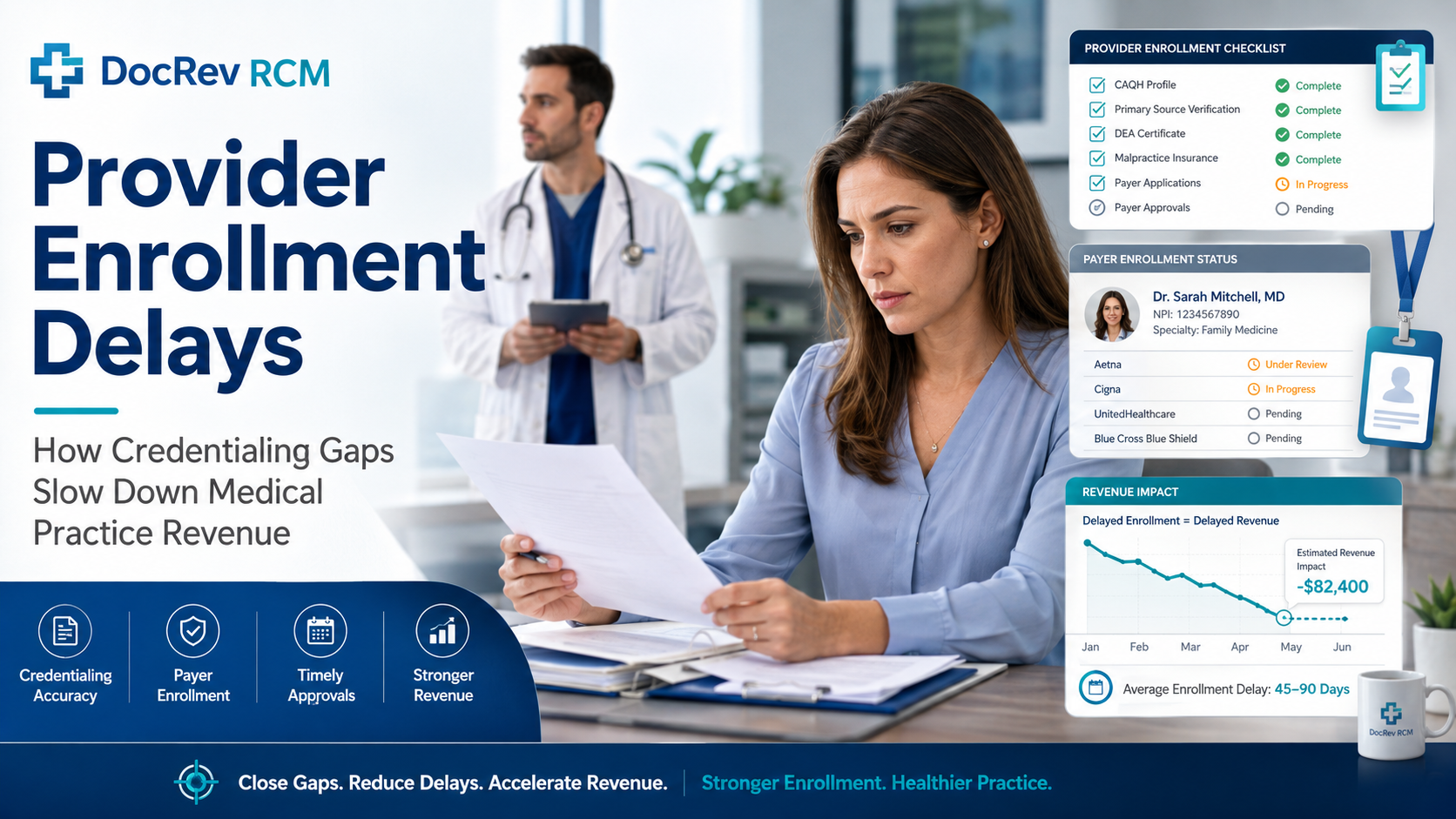
A provider may be fully ready to see patients.
They may have the right experience, the right license, the right schedule, and a full list of patients waiting.
But if credentialing and payer enrollment are not complete, the practice may still not be ready to bill correctly.
That is where many medical practices lose time, revenue, and control.
Provider enrollment delays can create a difficult gap between clinical readiness and billing readiness. A new provider may join the practice, but claims may still be delayed because the payer has not completed enrollment. A location may open, but payer records may not be updated. A CAQH profile may look complete, but one missing detail can hold up the process. A payer application may be submitted, but no one may be tracking it closely enough.
To the clinical team, everything looks active.
To the billing team, the provider may still not be fully billable.
That gap can slow down revenue before the first clean claim is even submitted.
This is why provider credentialing and payer enrollment should not be treated as simple paperwork. It is part of the revenue cycle. When it is delayed, billing gets delayed. When billing gets delayed, payments slow down. When payments slow down, A/R can grow before the practice even understands the cause.
At DocRev RCM, we help healthcare practices manage provider credentialing and payer enrollment services, medical billing services, and complete revenue cycle management services. The goal is simple: help providers stay ready to bill, reduce avoidable delays, and keep the revenue cycle moving with better structure.
In this blog, we will explain why provider enrollment delays happen, how credentialing gaps affect medical practice revenue, and how the right RCM partner can help prevent these issues before they become expensive.
Why Provider Enrollment Delays Are a Revenue Problem
Many practices look at credentialing as an administrative task.
That is the first mistake.
Credentialing and payer enrollment directly affect whether a provider can bill payers correctly. If the provider is not properly enrolled, the practice may face delayed claims, payer rejections, payment problems, or extra billing work.
This can become especially stressful when a provider is already seeing patients.
The practice may have payroll costs, scheduling costs, front desk work, clinical support, supplies, overhead, and patient demand. But if the provider is not enrolled with key payers, the revenue may not move at the same speed as the work being done.
That is why credentialing gaps can affect cash flow.
A provider can be productive clinically while still creating billing risk financially.
This is the problem many practices do not see early enough.
Credentialing vs. Payer Enrollment: What Practices Need to Understand
Credentialing and payer enrollment are connected, but they are not exactly the same.
A practice needs both handled correctly.
What Is Provider Credentialing?
Provider credentialing is the process of verifying a healthcare provider’s professional background.
This can include reviewing details such as education, training, licenses, certifications, work history, malpractice coverage, board status, professional references, and other required documents.
The purpose is to confirm that the provider meets the payer’s or organization’s standards.
Credentialing helps prove that the provider is qualified.
What Is Payer Enrollment?
Payer enrollment is the process of getting that provider enrolled with insurance payers so the practice can bill for covered services.
This may include submitting payer applications, connecting the provider to the group, updating tax and billing information, tracking payer responses, and confirming effective dates.
Enrollment helps make the provider billable with the payer.
Why the Difference Matters
A provider may be credentialed but still not fully enrolled with a payer.
A provider may have documents ready but still be waiting for payer approval.
A payer may approve enrollment, but the effective date may not match what the practice expected.
A provider may be linked to one payer but not another.
This is why the process needs careful tracking.
When practices treat credentialing and payer enrollment as one simple task, important details can get missed.
Where Credentialing Gaps Usually Start
Credentialing delays usually do not happen for one reason only.
They often come from small gaps that stack up over time.
Here are the most common areas where problems begin.
1. Incomplete Provider Information
Small missing details can delay the entire process.
A provider file may be missing work history, license details, malpractice information, board certification status, education records, or practice location details.
Sometimes the information is available, but it is not organized properly. Sometimes the provider sends documents in different formats. Sometimes old information is copied into a new application without being checked carefully.
This creates back-and-forth with the payer.
Every correction adds more time.
A strong credentialing process starts with a clean provider file before payer applications are submitted.
2. Outdated CAQH Profiles
CAQH is a major part of the credentialing process for many payers.
When CAQH information is outdated, incomplete, or not attested, payer enrollment can slow down.
Common CAQH problems include old practice addresses, expired documents, missing malpractice coverage, incorrect contact details, outdated license information, incomplete work history, and missing re-attestation.
A payer may not move forward if the CAQH profile does not match the application.
That is why CAQH maintenance is not a one-time task. It needs regular review.
For a busy practice, this can easily be missed unless someone owns the process.
3. Missing Licenses or Documents
Credentialing requires documentation.
When documents are missing, expired, or hard to verify, the process can pause.
This can include state licenses, DEA details where applicable, board certification, malpractice insurance, W-9 forms, EIN information, NPI details, practice location information, banking details, and payer-specific forms.
A missing document may look like a small issue, but it can stop an application from moving.
This is why practices should have a credentialing checklist for every provider before starting payer enrollment.
4. NPI, Tax ID, or Group Information Errors
Credentialing and payer enrollment depend on accurate provider and practice information.
If the NPI, Tax ID, billing address, service location, group name, or provider details do not match across systems, payers may request corrections.
These errors can create problems later in billing too.
For example, a claim may be submitted correctly from a coding point of view, but the payer may still have an issue if the provider or group enrollment information does not match.
That is why credentialing and billing teams need to communicate.
Enrollment data is not separate from billing data.
It affects claim payment.
5. Poor Payer Application Tracking
Submitting an application is not the end of the process.
It is only the beginning.
Payers may request more information. They may ask for corrections. They may need signatures. They may require follow-up. They may have different timelines. They may have closed panels or additional review steps.
If no one tracks the application closely, it can sit without movement.
This is one of the biggest reasons practices experience enrollment delays.
A good payer enrollment process should track submission date, payer name, provider name, application type, requested documents, current status, follow-up date, payer response, effective date, and final confirmation.
Without tracking, the practice is guessing.
With tracking, the practice can manage the process.
6. Revalidation and Recredentialing Issues
Credentialing does not end after the provider is approved.
Many payers require recredentialing, revalidation, or periodic updates.
If these are missed, the provider’s enrollment status can become a problem.
Practices should not wait until a payment issue appears before reviewing credentialing status.
Revalidation and recredentialing should be monitored before deadlines become urgent.
How Enrollment Delays Affect Medical Billing
Provider enrollment delays do not stay inside the credentialing department.
They affect the billing process.
Here is how.
Claims May Be Delayed
If a provider is not active with a payer, the billing team may need to hold claims or delay submission until enrollment is complete.
That can slow down cash flow.
Even when the provider is delivering care, the practice may not be able to collect smoothly.
Claims May Need Extra Review
When enrollment details are unclear, billing teams may spend extra time checking payer status, effective dates, group linkage, and claim rules before submission.
This slows down normal billing work.
A/R Can Grow Before the Practice Notices
Enrollment issues can create claims that sit unpaid, pending, or delayed.
Over time, this can increase A/R.
DocRev RCM’s accounts receivable services help practices follow up on unpaid claims, track payer issues, and reduce aging balances.
Billing Teams Spend More Time Fixing Preventable Issues
Credentialing gaps create rework.
The billing team may need to contact payers, correct claim details, check enrollment status, resubmit claims, or explain delays to the practice.
That time could have been used for cleaner billing, faster follow-up, and better revenue cycle management.
New Provider Revenue Can Start Slowly
When a new provider joins, the practice expects that provider to contribute to revenue.
But if payer enrollment is delayed, the provider’s financial ramp-up may be slower than expected.
This can affect staffing plans, scheduling decisions, and practice growth.
Why Credentialing Should Start Before the Provider’s First Day
Many practices wait too long to begin credentialing.
They start the process close to the provider’s start date, then realize payer enrollment may take more time than expected.
That creates pressure for everyone.
The provider is ready. Patients are waiting. The schedule is being built. But payer approvals are still pending.
A better approach is to start credentialing and payer enrollment as early as possible.
Before a provider’s first day, the practice should already be reviewing provider documents, licenses and certifications, NPI details, CAQH status, malpractice coverage, practice location details, payer list, application requirements, and expected payer timelines.
This gives the practice more control.
It also reduces the chance that billing readiness becomes an afterthought.
When Practices Should Review Credentialing and Enrollment Status
Credentialing should not only be reviewed when a problem appears.
It should be reviewed during key practice changes.
A practice should review credentialing and enrollment when a new provider is joining, a provider is leaving, a provider changes location, a new practice location opens, a practice adds a new payer, a payer contract changes, a provider changes name or license details, CAQH needs re-attestation, a revalidation deadline is coming, claims start getting delayed, or billing reports show payer-related problems.
These reviews help prevent small administrative issues from becoming bigger billing issues.
Why Specialty Practices Need Stronger Credentialing Support
Specialty practices often face more complicated billing and payer requirements.
They may deal with procedure-based services, higher-value claims, hospital and office service locations, prior authorizations, recurring care, and specialty-specific payer rules.
That means credentialing mistakes can create bigger problems.
For example, a specialty provider may be approved for one payer but not properly linked to the right group or location. A payer may require specific enrollment details before certain services can be billed. A provider may be clinically ready to perform services, but payer enrollment may not support smooth reimbursement yet.
DocRev RCM supports specialty medical billing services across many practice types, including pulmonology, nephrology, cardiology, internal medicine, urgent care, family practice, behavioral health, wound care, ENT, and more.
For specialty practices, credentialing and payer enrollment should be connected with medical billing from the beginning.
That helps reduce avoidable billing problems later.
How Credentialing Connects With Revenue Cycle Management
Revenue cycle management is not only about claims after the visit.
It starts before the patient is seen.
Credentialing is one of the earliest steps in that process.
If a provider is not properly enrolled, the rest of the revenue cycle can suffer.
A clean revenue cycle depends on accurate provider information, active payer enrollment, proper group linkage, correct billing setup, eligibility verification, clean claim submission, payment posting, A/R follow-up, and denial prevention.
This is why revenue cycle management services should include communication between credentialing, billing, eligibility, and A/R teams.
When these areas work separately, problems can slip through.
When they work together, the practice has a stronger chance of preventing revenue delays.
How Credentialing Gaps Can Create Denials and A/R Problems
A credentialing issue may not always show up immediately.
Sometimes it appears later as a billing problem.
Claims may be delayed because provider data does not match payer records. Payments may not process smoothly because the payer has not updated the provider’s enrollment. A/R may grow because claims are waiting on enrollment confirmation. Billing teams may keep following up without knowing the root cause is credentialing.
That is why denial management and A/R follow-up need to connect back to credentialing.
DocRev RCM’s denial management services help practices review denied claims, identify root causes, and reduce repeat problems.
But the stronger approach is prevention.
When credentialing is handled correctly from the start, the practice reduces avoidable billing friction later.
Common Mistakes Practices Make With Provider Enrollment
Many credentialing problems come from a few common mistakes.
Waiting Too Long to Start
Credentialing and payer enrollment can take time. Starting too late creates pressure and increases the chance of delayed billing.
Not Keeping CAQH Updated
An outdated CAQH profile can delay payer review and create unnecessary back-and-forth.
Treating Every Payer the Same
Each payer may have different requirements, forms, timelines, and follow-up steps.
Not Tracking Effective Dates
A payer approval is important, but the effective date is just as important. The practice needs to know when the provider can bill.
Poor Communication Between Billing and Credentialing
Billing teams need credentialing status before claims are submitted. Credentialing teams need to know when billing issues suggest an enrollment problem.
Missing Revalidation Deadlines
Revalidation and recredentialing should be monitored before they create payment delays.
Not Reviewing Group and Location Details
Provider enrollment must match the practice’s billing structure, service locations, and payer setup.
What a Strong Credentialing and Enrollment Process Should Include
A strong process should be organized, trackable, and connected to billing.
It should include provider document collection, license and certification review, CAQH setup and maintenance, NPI and taxonomy review, practice and group information review, payer application preparation, payer submission tracking, follow-up management, status reporting, effective date confirmation, revalidation tracking, and communication with billing teams.
This is where professional medical credentialing services can help.
The goal is not only to submit applications.
The goal is to keep the provider ready to bill correctly.
How DocRev RCM Helps With Credentialing and Payer Enrollment
DocRev RCM helps practices manage credentialing and enrollment with a structured approach.
The process is designed to reduce confusion, organize provider information, track payer applications, and support billing readiness.
Provider Credentialing and Payer Enrollment Services
DocRev RCM provides provider credentialing and payer enrollment services to help practices manage provider onboarding, payer applications, enrollment tracking, and credentialing maintenance.
This helps providers stay connected to the payers they need to bill.
Medical Billing Services
Credentialing and billing should work together.
DocRev RCM’s medical billing services help practices manage claim creation, claim submission, payment posting, secondary billing, patient balances, and billing workflow support.
When provider enrollment is properly tracked, billing can move with fewer avoidable delays.
Revenue Cycle Management Services
DocRev RCM’s revenue cycle management services connect the full process from patient access to final payment.
Credentialing is part of that full cycle because a provider must be properly enrolled before billing can run smoothly.
Eligibility Verification Services
DocRev RCM’s eligibility verification services help practices confirm patient coverage before services are billed.
When eligibility verification and provider enrollment are both handled properly, the practice has a stronger front-end revenue cycle.
A/R Follow-Up
DocRev RCM’s account receivable services help practices follow up on unpaid claims and identify where revenue is getting stuck.
If A/R problems are connected to enrollment issues, those patterns need to be found early.
Denial Management
DocRev RCM’s denial management services help practices review claim issues, correct errors, and reduce repeat billing problems.
Enrollment-related claim issues should not be treated as random. They should be traced back to the source.
Why Outsourcing Credentialing Can Make Sense
Some practices try to manage credentialing fully in-house.
That can work if the team has time, payer knowledge, organized tracking, and strong follow-up.
But many practices are already overloaded.
The same staff handling calls, scheduling, eligibility, billing questions, payer follow-up, and patient issues may also be expected to manage credentialing.
That creates risk.
Credentialing needs attention to detail and consistent follow-up. One missed update can delay an application. One outdated CAQH profile can slow payer review. One missing document can pause enrollment. One missed revalidation can affect billing.
Outsourcing credentialing can help when the practice needs clean provider onboarding, better payer tracking, regular CAQH maintenance, revalidation monitoring, organized documentation, billing-ready enrollment, and less pressure on internal staff.
This is especially useful for growing practices, specialty practices, multi-provider groups, and practices that are adding locations or payers.
Questions to Ask Before Choosing a Credentialing Partner
A good credentialing partner should do more than collect forms.
Before choosing support, practices should ask:
- Do they understand both credentialing and medical billing?
- Do they track payer applications until completion?
- Do they maintain CAQH profiles?
- Do they monitor revalidation and recredentialing needs?
- Do they confirm effective dates?
- Do they communicate status clearly?
- Do they understand group enrollment and location updates?
- Do they connect credentialing issues with billing and A/R problems?
- Do they support specialty practices?
- Do they provide a clear next step when payer delays happen?
The right partner should help the practice stay organized and ready to bill.
The Real Cost of Credentialing Gaps
The real cost of credentialing gaps is not only the time spent fixing applications.
It is the revenue delay.
It is the claim work that cannot move properly. It is the new provider who cannot contribute revenue as expected. It is the A/R that grows because payer information is not ready. It is the billing team spending time chasing issues that could have been prevented. It is the practice owner wondering why a provider is seeing patients but collections are still slow.
Credentialing gaps create friction before the revenue cycle even begins.
That is why credentialing should be treated as a revenue protection function.
Not paperwork.
Not a side task.
Not something to handle only when there is a problem.
It should be part of the practice’s billing strategy.
Final Thoughts
Provider enrollment delays can quietly slow down medical practice revenue.
A provider may be clinically ready, but the practice may not be financially ready to bill until credentialing and payer enrollment are complete.
That gap can create delayed claims, payment issues, A/R growth, billing confusion, and extra work for the team.
The good news is that many credentialing problems can be prevented with better organization, earlier onboarding, CAQH maintenance, payer tracking, revalidation monitoring, and stronger communication between credentialing and billing.
DocRev RCM helps practices manage provider credentialing, payer enrollment, medical billing, revenue cycle management, eligibility verification, denial management, and A/R follow-up with a cleaner and more organized process.
When credentialing is handled properly, providers can start stronger, billing teams can work with more confidence, and practices can protect revenue from the beginning.
Ready to Reduce Provider Enrollment Delays?
If your practice is adding a new provider, opening a new location, joining new payer networks, or struggling with enrollment-related billing delays, DocRev RCM can help.
Visit DocRev RCM or request a consultation through the Contact Us page.
Let your providers focus on patient care while DocRev RCM helps keep credentialing, enrollment, and billing readiness moving in the right direction.
FAQs
1. What is provider credentialing?
Provider credentialing is the process of verifying a healthcare provider’s professional qualifications, including education, training, licenses, certifications, malpractice coverage, work history, and other required documents.
2. What is payer enrollment?
Payer enrollment is the process of enrolling a healthcare provider with insurance payers so the practice can bill for covered services under the correct provider, group, location, and payer information.
3. What is the difference between credentialing and payer enrollment?
Credentialing verifies that the provider is qualified. Payer enrollment connects that provider with insurance payers for billing purposes. A provider may have credentials ready but still need payer enrollment approval before billing can run smoothly.
4. Why do provider enrollment delays affect revenue?
Provider enrollment delays can affect revenue because claims may be held, delayed, rejected, or paid incorrectly when provider or payer information is incomplete, outdated, or not fully approved.
5. What causes credentialing delays?
Common causes include incomplete applications, outdated CAQH profiles, missing documents, NPI or Tax ID errors, payer application backlogs, poor follow-up, closed payer panels, and missed revalidation requirements.
6. Why is CAQH important in credentialing?
CAQH is used by many payers to review provider information. If the CAQH profile is outdated, incomplete, or not attested, payer enrollment can slow down.
7. When should a practice start credentialing a new provider?
A practice should start credentialing as early as possible before the provider’s start date. Waiting too long can create billing delays after the provider begins seeing patients.
8. How does credentialing connect with medical billing?
Credentialing connects with medical billing because provider enrollment status affects whether claims can be submitted and paid correctly. Billing teams need accurate provider and payer enrollment information to avoid payment delays.
9. Does DocRev RCM provide provider credentialing and payer enrollment services?
Yes. DocRev RCM provides provider credentialing and payer enrollment services, along with medical billing, revenue cycle management, denial management, eligibility verification, A/R follow-up, and specialty billing support.
10. How can I contact DocRev RCM for credentialing support?
You can contact DocRev RCM through the Contact Us page and request help with credentialing, payer enrollment, billing, or revenue cycle management.