
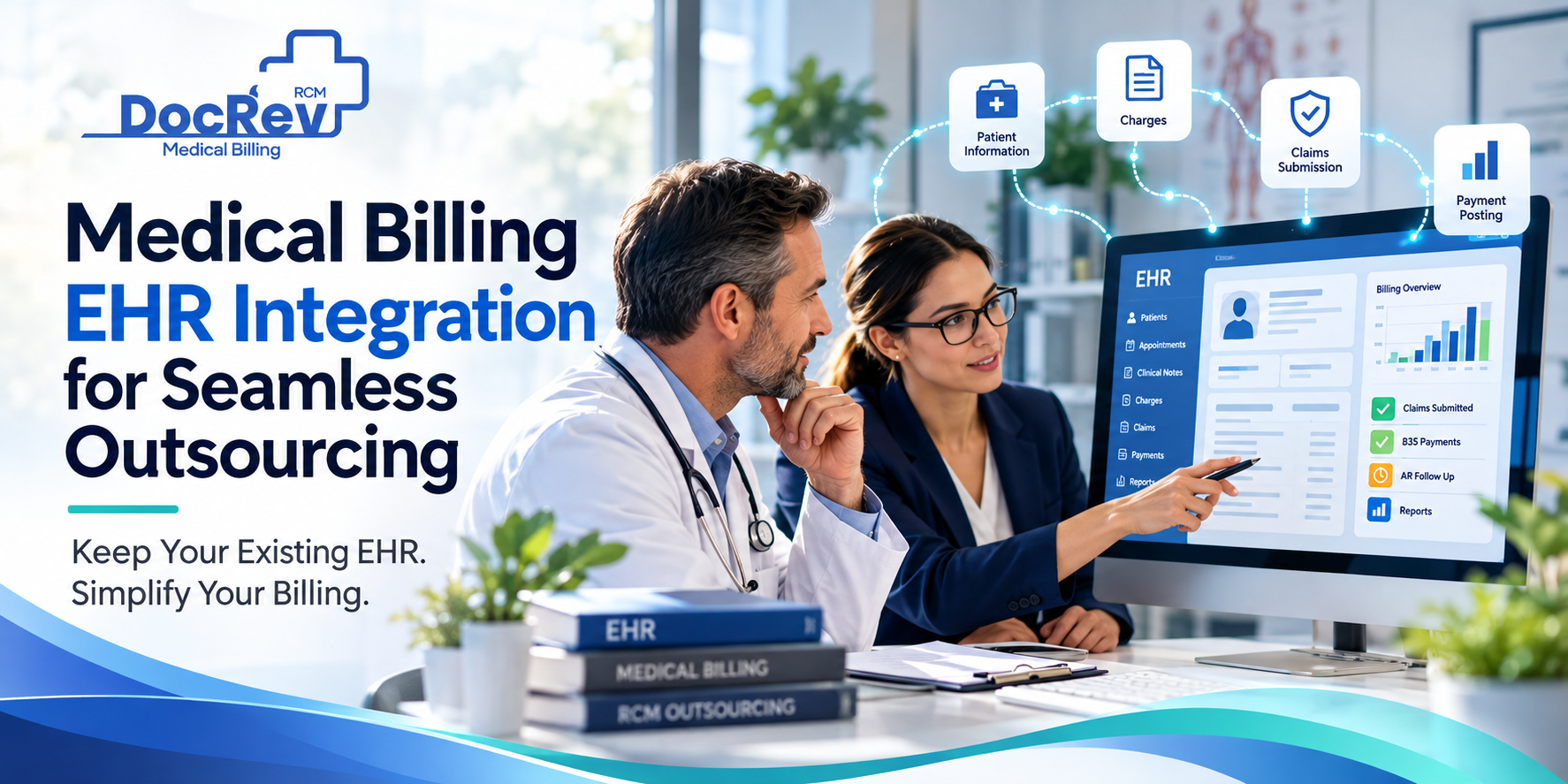
For many healthcare practices, the decision to outsource medical billing comes with an unexpected concern: what happens to the systems the practice already uses? Physicians and practice administrators may be interested in reducing billing workload and improving revenue cycle management, but they may not want to replace their EHR, change their practice management software, or force their staff to learn an entirely new workflow.
That concern is understandable. An EHR is part of the daily operation of a medical practice. Providers use it to document encounters, staff use it to manage patient information, and administrative teams depend on it for billing-related activities. Changing that environment simply because a practice wants to work with an outside billing company can create unnecessary disruption.
This is where medical billing EHR integration becomes important. A well-planned outsourcing arrangement can allow a medical billing company to work within the systems and workflow the practice already uses instead of requiring the practice to rebuild its entire operation around a new platform.
For healthcare practices considering outsourced billing, the real question is not simply whether a billing company can submit claims. The more important question is whether the billing company can fit into the practice's existing environment, understand how information moves through that environment, and take responsibility for the billing work without creating additional administrative pressure.
DocRev RCM provides medical billing services designed to work within the EHR and practice management systems available to a healthcare organization. This approach allows practices to consider outsourcing without automatically making a software migration part of the decision.
What Medical Billing EHR Integration Actually Means
Medical billing EHR integration does not always mean building a completely new software system or creating a complicated technology project. In many outsourced billing arrangements, integration is primarily about making sure the billing team can work appropriately within the systems, information, permissions, and processes already used by the practice.
The exact setup depends on the EHR, practice management platform, clearinghouse, workflow, and scope of services involved. Some practices may provide authorized access to their existing systems, while others may use established data exchange processes or connected billing platforms. The technical approach should be determined during onboarding rather than assumed to be identical for every healthcare organization.
What matters most is that the transition does not create unnecessary duplication. The practice should not have to enter the same information into multiple systems simply because billing has been outsourced. The billing team should understand where information originates, how it moves through the revenue cycle, and where completed billing activity needs to be recorded.
This creates a more practical definition of integration: the billing partner becomes part of the existing financial workflow without forcing the clinical team to abandon the tools they already depend on.
Why Practices Hesitate to Outsource Medical Billing
Outsourcing medical billing can look attractive when internal staff are spending too much time on claims, payer follow-up, payment posting, or other administrative work. However, practices sometimes hesitate because they are concerned that an outside company will create more work during the transition.
A practice may already have years of information inside its EHR and practice management system. Staff may know exactly where to find patient information, charges, claims, payment records, and other billing details. Physicians may already have an established documentation process. Replacing the technology simply to accommodate a billing company can therefore seem unnecessary.
There can also be concern about disruption. Staff need to know who is responsible for billing tasks, where questions should be sent, how problems will be escalated, and how the practice will maintain visibility into billing performance after outsourcing.
A well-structured onboarding process should address these concerns before production billing begins. The billing company and practice should establish responsibilities, access requirements, communication procedures, workflow expectations, and reporting needs so both sides understand how the relationship will operate.
The objective should be a controlled transition, not a complete reinvention of the practice's technology environment.
Keeping Your Existing EHR Can Make the Transition Easier
Your EHR is already familiar to your clinical and administrative teams. Providers understand how to document patient encounters, staff understand the patient workflow, and the practice has established procedures for managing information. Keeping that environment can reduce the number of changes employees need to manage when billing is outsourced.
Instead of asking physicians to learn a new system for clinical documentation or requiring the front desk to maintain an additional workflow, an outsourced billing team can work within the systems and processes made available by the practice.
This separation can be valuable because clinical operations and billing operations have different responsibilities. The clinical team should remain focused on patient care and accurate documentation, while the billing team handles the financial processes assigned to it.
When the two functions are connected through an organized workflow, outsourcing can reduce administrative pressure without requiring the practice to replace the technology it already uses.
How EHR and Billing Workflows Connect
The billing process begins with information generated during the patient encounter. Documentation provides the foundation for understanding what services were performed, while the billing workflow uses the appropriate information to prepare charges and claims.
Once the necessary information reaches the billing workflow, the billing team can review the available data, prepare the claim, submit it through the appropriate electronic process, and monitor what happens after submission. Payments, adjustments, rejections, and other payer responses then become part of the continuing revenue cycle.
When these activities are managed inside a connected workflow, there is less need for unnecessary manual duplication. The practice can maintain its established clinical system while the billing team performs its assigned financial responsibilities within the approved environment.
This is one reason medical billing EHR integration should be discussed during the initial conversation with a billing company rather than after the outsourcing agreement has already been signed.
What Should Be Reviewed Before Medical Billing Integration?
Every practice has a different technology environment. Some organizations operate with a single EHR and practice management system, while others use separate systems for clinical documentation, scheduling, billing, clearinghouse activity, and financial reporting.
Before outsourcing begins, the billing company should understand the systems the practice uses and determine how billing work will be performed within that environment. The discussion should cover the information required for charge entry, claim preparation, payment posting, follow-up, reporting, and other services included in the agreement.
Access should also be considered carefully. The billing team should receive only the access required to perform its responsibilities, with appropriate permissions and controls established by the practice and its systems.
The practice should also establish who is responsible for each stage of the workflow. Clear ownership prevents confusion when information is missing, a claim needs attention, or a payer response requires follow-up.
These decisions may sound operational, but they have a direct effect on how smoothly outsourcing works after the transition.
Medical Billing Integration Should Not Create Duplicate Work
One of the biggest benefits of a well-designed outsourced billing workflow is the reduction of unnecessary administrative duplication.
If a practice has to enter charges into one system and then manually recreate the same information somewhere else for its billing company, outsourcing can become more complicated than it needs to be. Duplicate entry can also create opportunities for inconsistencies between records.
A better approach is to establish where the original information is created and how the billing team accesses or receives the information required to complete its work.
The exact method depends on the practice's technology and the services being outsourced, but the underlying principle remains the same: information should move through a defined process with clear responsibility at each stage.
This is particularly important for practices with high patient volume. When a workflow is repeated hundreds or thousands of times, even a small unnecessary step can create a significant administrative burden.
How EHR Integration Supports Claim Processing
Claim preparation depends on accurate information. The billing team needs access to the relevant patient, provider, encounter, insurance, and service information required for the claim.
When the billing process is connected appropriately to the practice's existing environment, the team can work from the information available within the approved workflow rather than relying on disconnected records.
This can help create greater consistency between what the practice documents and what the billing team submits. It also gives the billing team a clearer understanding of where information comes from and where billing-related updates should be recorded.
However, integration alone does not guarantee accurate claims. The quality of the underlying documentation, coding, patient information, payer requirements, and billing processes still matters. Technology provides the connection, but the people and processes operating within that connection determine how effectively the revenue cycle performs.
Payment Posting and Billing Integration
Medical billing does not end when a claim is submitted. Once a payer processes the claim, payment and adjustment information must be recorded accurately so the practice can understand what has been paid and what remains unresolved.
An integrated workflow helps the billing team maintain continuity between submitted claims and subsequent financial activity. Payment information can be posted according to the established process, while unresolved balances can move into the appropriate follow-up workflow.
This gives the practice a clearer financial record without requiring staff to manually recreate billing activity in unrelated systems.
For practices outsourcing payment posting as part of their billing engagement, the integration discussion should therefore include how payments, adjustments, patient responsibility, and related information will be handled inside the existing environment.
How Integration Can Support Denial Management
When a claim does not process as expected, the billing team needs access to the information necessary to understand the issue and determine the appropriate next step.
A connected workflow makes it easier to relate the payer response to the original billing activity. The billing team can review the available claim information, identify the reason for the rejection or denial, and follow the practice's established process for correction, resubmission, or appeal when appropriate.
This does not mean that every denial is caused by an integration problem. Denials can occur for many different reasons. The value of integration is that it gives the billing team a more organized environment in which to investigate and manage those issues.
Practices that need dedicated support can also use denial management services as part of a broader revenue cycle strategy.
Protecting Information During EHR-Based Billing Outsourcing
Healthcare practices handle sensitive patient information, so security and privacy should be considered whenever an outside company receives access to an EHR or billing environment.
The practice and billing company should establish appropriate access controls, user permissions, authentication procedures, and responsibilities before work begins. Access should be limited to what is necessary for the services being performed, and the workflow should follow applicable privacy and security requirements.
HIPAA compliance is also an important consideration when healthcare organizations work with outside vendors that handle protected health information. The practice should understand how the billing relationship is structured and what safeguards are in place for the information being accessed.
Technology should make the billing process more connected without compromising the responsibility healthcare organizations have to protect patient information.
What the Onboarding Process Should Look Like
A successful medical billing integration usually begins before the billing team starts working on live accounts. The onboarding stage gives the practice and billing company an opportunity to understand the existing environment and establish how responsibilities will be divided.
The first step is understanding the practice itself. The billing company needs to know the specialties involved, payer mix, patient volume, existing billing workflow, systems in use, current accounts receivable, and the services included in the engagement.
The next stage is reviewing system access and workflow requirements. This is where the parties determine how billing information will be accessed, how claims will be handled, how payments will be posted, and how questions or exceptions will be communicated.
Training and workflow familiarization are also important. The billing team needs to understand how the practice uses its systems, while the practice needs to understand how to communicate with the billing team and where to find relevant billing information.
Before full production begins, both sides should have a clear understanding of responsibilities and escalation procedures. A controlled transition gives the practice an opportunity to address workflow questions before they become operational problems.
Can a Practice Outsource Billing Without Changing Its EHR?
In many cases, yes. A practice does not automatically need to replace its EHR simply because it decides to outsource medical billing. The actual answer depends on the EHR, practice management platform, available access, technical capabilities, and the scope of billing services involved.
The important point is that outsourcing and software replacement are two separate decisions. A practice can evaluate whether it needs a different EHR for clinical or operational reasons without making that decision part of its billing outsourcing process.
For practices that are satisfied with their current system, the first conversation with a billing company should therefore focus on compatibility, access, workflow, responsibilities, and integration requirements.
DocRev RCM works within the EHR and practice management systems available during onboarding, allowing healthcare practices to maintain their existing clinical workflow while receiving outsourced billing support.
When EHR Integration Becomes Especially Important
EHR integration becomes increasingly important as a practice grows. More providers, more patient encounters, additional locations, and increasing billing volume can make manual processes harder to manage.
A workflow that seems manageable for a small practice may become inefficient when the number of daily transactions increases. If the billing team and clinical staff are constantly transferring information manually, the administrative burden can grow along with the practice.
Integration also becomes important when a practice uses multiple connected systems. Scheduling, clinical documentation, billing, clearinghouse activity, payment posting, and reporting may involve several platforms. The billing company needs to understand how these systems interact so that outsourced work fits into the broader operation.
This is why integration should be viewed as a workflow decision rather than simply a technology feature.
Choosing a Medical Billing Company That Fits Your Existing Workflow
When evaluating a medical billing company, healthcare practices should look beyond the promise of claim submission or a particular collection percentage. The more important question is whether the billing company can operate effectively within the practice's existing environment.
Ask how the company handles your current EHR, what access it requires, how information moves between the practice and billing team, how payment information is handled, and how reporting is provided.
It is also worth discussing what happens during onboarding. A billing partner should be able to explain how the transition will be managed, what information is needed from the practice, who will be responsible for different tasks, and how communication will work once the account is live.
The best arrangement is one where the technology supports the relationship instead of becoming another obstacle for the practice.
How DocRev RCM Approaches Medical Billing Integration
DocRev RCM provides outsourced medical billing and revenue cycle management support for healthcare practices across the United States. Its billing workflow is designed to work within the EHR and practice management systems available to the practice rather than requiring the organization to rebuild its clinical workflow simply to outsource billing.
The medical billing process can include charge entry, claim preparation and submission, payment posting and reconciliation, secondary and tertiary billing, patient statements, rejection correction, and billing follow-up. These functions can be connected with broader revenue cycle services when a practice needs additional support.
For practices that need a more complete solution, revenue cycle management services can connect billing with eligibility, denial management, accounts receivable, and other financial processes.
This approach gives practices the opportunity to outsource the administrative side of their revenue cycle while continuing to work with the systems their teams already know.
Make Medical Billing Outsourcing Easier Without Rebuilding Your Practice
Outsourcing medical billing should solve an administrative problem, not create a new technology problem. If a practice is already comfortable with its EHR and practice management environment, replacing those systems should not automatically be part of the outsourcing decision.
Medical billing EHR integration allows practices to think about outsourcing differently. Instead of asking whether they need to change their software, they can focus on whether the billing partner can work effectively within the existing environment.
A successful arrangement depends on more than technical access. It requires clear responsibilities, appropriate permissions, organized workflows, reliable communication, accurate billing processes, and useful reporting. When those pieces are established before production begins, the transition can be much easier for both the practice and the billing team.
For healthcare organizations considering outsourced billing, the right partner should fit the practice's operation rather than forcing the practice to fit the partner's process.
DocRev RCM works with healthcare practices to manage medical billing and broader revenue cycle operations within the systems and workflows available to the organization. If your practice is considering outsourcing but does not want to disrupt its existing EHR environment, contact DocRev RCM to discuss your current billing workflow and determine what type of support fits your practice.
Frequently Asked Questions
Can I outsource medical billing without changing my EHR?
In many cases, yes. Outsourcing medical billing does not automatically require a practice to replace its EHR. The specific approach depends on the EHR, practice management system, available access, technical capabilities, and the scope of services being outsourced.
What is medical billing EHR integration?
Medical billing EHR integration is the process of connecting an outsourced billing workflow with the EHR and practice management environment already used by a healthcare organization. Depending on the systems involved, this may involve authorized system access, established data exchange, or other workflow arrangements.
Will outsourcing billing disrupt our clinical workflow?
A properly planned outsourcing arrangement should be designed to minimize disruption to clinical operations. The billing team should understand the practice's existing workflow, responsibilities should be clearly assigned, and system access should be established before production billing begins.
What information does a billing company need from an EHR?
The information required depends on the services being provided and the systems involved. Billing teams may need access to information necessary for charge entry, claim preparation, insurance details, payment posting, claim follow-up, and reporting. Access should be limited to what is necessary for the agreed responsibilities.
Does EHR integration improve medical billing?
EHR integration can make billing workflows more organized by reducing unnecessary duplication and helping billing teams work from information already maintained within the practice's approved systems. However, integration by itself does not guarantee better billing results. Accurate documentation, coding, claim management, follow-up, and other revenue cycle processes remain important.
How does an outsourced billing company work with an existing EHR?
The billing company may work within the practice's existing EHR or practice management environment using authorized access and an agreed workflow. The exact process varies by system and service scope, so the integration and access requirements should be established during onboarding.
Is EHR integration important when choosing a medical billing company?
Yes. A billing company's ability to work within the practice's existing technology environment can affect onboarding, daily workflow, communication, and administrative workload. Practices should understand how the company will access information and manage billing responsibilities before signing an outsourcing agreement.
Can DocRev RCM work with an existing EHR?
DocRev RCM works within the EHR and practice management systems and access available during onboarding. This allows healthcare practices to consider outsourced billing support without automatically rebuilding their existing clinical workflow.
What should a practice discuss before outsourcing medical billing?
The practice should discuss EHR and practice management compatibility, system access, billing responsibilities, onboarding, communication, reporting, payment posting, claim management, and the scope of services included in the agreement. Establishing these expectations early can help create a smoother transition.