
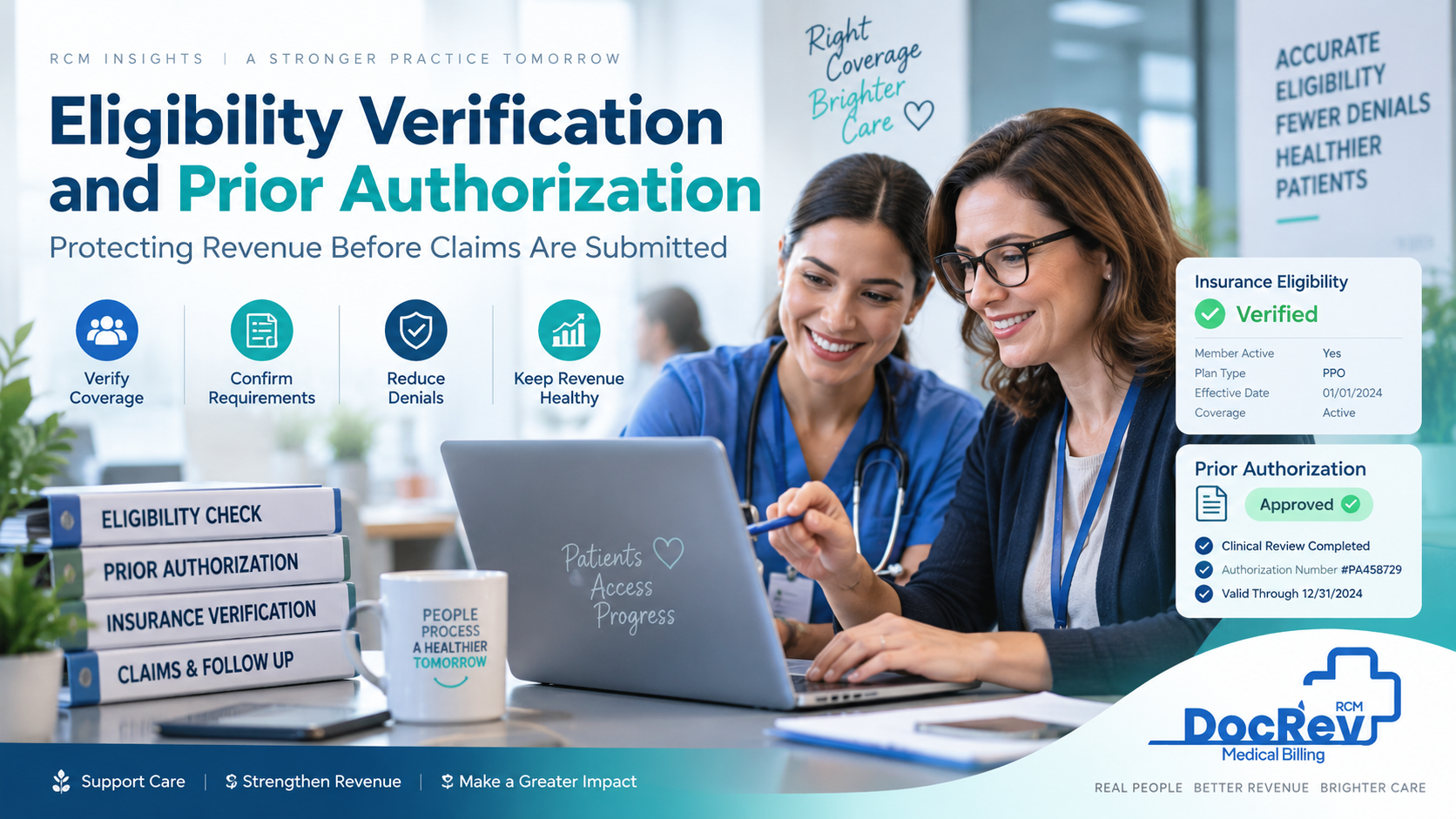
A clean medical claim does not start when the biller submits it. It starts before the patient is seen. This is where many medical practices miss the bigger picture.
A patient may be scheduled, the provider may be ready, and the visit may happen on time. But if insurance eligibility is not checked properly, benefits are unclear, patient responsibility is not reviewed, or prior authorization is missing, the billing problem has already started.
By the time the claim reaches the payer, the practice may already be dealing with avoidable delays. This is why eligibility verification and prior authorization are not small front-desk tasks. They are front-end revenue cycle steps that help protect practice revenue before claims are submitted.
When this process is weak, practices may face delayed payments, avoidable claim issues, confused patients, old A/R, extra payer follow-up, and more pressure on the billing team. When this process is strong, the practice has a better chance of submitting cleaner claims, setting clearer patient expectations, and reducing avoidable revenue cycle problems.
At DocRev RCM, we help healthcare practices strengthen front-end billing through eligibility verification services, medical billing services, revenue cycle management services, denial management, A/R follow-up, credentialing, and specialty billing support.
This blog explains why eligibility verification and prior authorization matter, how they affect collections, and how a stronger front-end RCM process can help practices protect revenue before billing problems begin.
Why Front-End RCM Matters Before the Claim Is Submitted
Many practices think revenue cycle management starts after the patient visit, but the revenue cycle begins much earlier. It starts when the patient is scheduled, insurance information is collected, benefits are checked, authorization rules are reviewed, and financial responsibility is identified.
This early stage is called front-end revenue cycle management. It includes the steps that happen before claim submission. These steps may not look as technical as coding, payment posting, or denial management, but they can decide whether the claim moves smoothly or gets stuck later.
A weak front-end process can create problems such as wrong insurance information, inactive coverage, missing referral details, missing prior authorization, unclear patient responsibility, wrong payer selection, wrong plan details, delayed claim submission, higher claim issue risk, and more A/R follow-up.
A strong front-end process helps reduce these problems before they reach the billing team. That is why eligibility verification and prior authorization should be treated as revenue protection steps, not just administrative work.
What Is Eligibility Verification?
Eligibility verification is the process of confirming whether a patient’s insurance coverage is active and what benefits apply before services are provided. In simple words, it helps the practice understand whether the patient is covered, which payer is active, what the plan may cover, whether a copay or deductible applies, whether coinsurance is involved, whether a referral is required, whether prior authorization is needed, and what the patient may owe.
These answers help the practice prepare before the claim is created. DocRev RCM’s insurance eligibility verification services help practices confirm insurance details, reduce avoidable front-end errors, and support cleaner billing workflows.
Eligibility verification is especially important because insurance information can change quickly. A patient may have new coverage, an inactive plan, a different payer, changed benefits, or new responsibility under the same plan. When that information is not checked, the practice may only find out after the claim is delayed. By then, the work becomes harder.
What Is Prior Authorization?
Prior authorization is the process of getting approval from the payer before certain services, procedures, tests, medications, or treatments are provided. Not every service needs prior authorization, but when it is required and not completed, the claim may face serious payment issues.
Prior authorization usually confirms that the payer has reviewed the request and approved the service based on plan rules, medical necessity, or coverage requirements. For medical practices, this process can involve checking whether authorization is required, collecting clinical details, submitting the request to the payer, tracking the payer response, confirming approval, recording the authorization number, checking the approved date range, and checking approved units or visits.
The important point is simple: prior authorization should be checked before the service is provided, not after the claim is delayed. When prior authorization is missed, the billing team may spend more time correcting issues, contacting the payer, appealing decisions, or explaining the problem to the patient and provider.
Eligibility Verification vs. Prior Authorization
Eligibility verification and prior authorization are connected, but they are not the same. Eligibility verification confirms whether the patient has active insurance coverage and what benefits apply. Prior authorization confirms whether the payer has approved a specific service before it is performed.
A patient can be eligible but still need prior authorization. For example, a patient may have active coverage, but the payer may still require approval before a diagnostic test, therapy session, imaging service, procedure, or specialty treatment.
This is where many practices get confused. They verify coverage and assume the service is ready, but eligibility does not always mean authorization. That gap can create billing delays later. A strong front-end RCM process checks both.
Why Eligibility and Authorization Problems Hurt Collections
Eligibility and authorization problems can affect revenue in several ways. They can delay claims, increase avoidable claim issues, create patient balance confusion, and increase follow-up work. These problems often begin before the visit, but they usually show up later inside billing reports, A/R, and payer follow-up.
Inactive or Incorrect Insurance Information
One of the most common front-end billing problems is incorrect insurance information. The patient may provide an old card. The payer may have changed. The member ID may be wrong. The plan may be inactive. The patient may have secondary insurance that was not collected.
When this information is wrong, the claim may not move smoothly. The billing team may need to correct the payer, update demographics, contact the patient, resubmit the claim, or wait for new information. That means extra work and delayed payment.
Medical insurance verification helps reduce this risk by confirming the correct payer, member details, plan status, and coverage before the visit.
Unclear Patient Responsibility
Patient responsibility is another major reason front-end verification matters. Before the visit, the practice should understand whether the patient has a copay, deductible, coinsurance, out-of-pocket balance, or other expected responsibility.
When this information is not reviewed, patients may be surprised later. That can create confusion, delayed collections, complaints, and more work for staff. Clear insurance eligibility and benefits verification helps the practice explain financial responsibility earlier and reduce uncomfortable conversations after the claim is processed.
This is not only good for collections. It also improves the patient experience.
Missing Prior Authorization Before the Visit
Missing prior authorization can create serious revenue cycle problems. A provider may perform the service correctly, the documentation may be strong, and the claim may be coded properly. But if the payer required authorization and the practice did not obtain it, the claim may still be delayed or denied.
This is why authorization checks should be built into the scheduling and eligibility workflow. The team should know whether authorization is required before the patient arrives. They should also track approval status, authorization numbers, approved dates, and allowed units or visits.
Without that structure, the practice is taking a risk before the service is even provided.
Wrong Payer or Plan Details
Sometimes the insurance is active, but the wrong plan information is used. This can happen when a patient has multiple plans, employer coverage changes, coordination issues, or secondary insurance.
Wrong payer details can create claim routing problems and payment delays. The claim may go to the wrong payer. Secondary billing may be delayed. Patient responsibility may be calculated incorrectly. Staff may spend extra time correcting the account.
A proper eligibility verification process helps confirm plan details before billing begins.
Delayed Claim Submission
When eligibility or authorization information is missing, the billing team may need to hold the claim. That means the practice has already provided care, but the claim cannot move forward properly.
Delayed submission affects cash flow. The longer a claim waits, the longer payment waits. A strong front-end process helps billing teams submit claims with more confidence because key information has already been checked.
More Denial Management and A/R Follow-Up
Eligibility and authorization problems often show up later as denial management and A/R issues. A claim problem that could have been prevented at the front end may later require payer calls, claim corrections, appeals, resubmissions, and follow-up.
That creates pressure on the billing team. DocRev RCM’s denial management services help practices review denied claims and reduce repeat issues. But the better approach is to prevent avoidable problems before they become larger billing issues.
DocRev RCM’s account receivable services also help practices follow up on unpaid claims and reduce aging balances when revenue gets stuck. The goal is not only to fix problems after they happen. The goal is to reduce how often they happen.
Why Specialty Practices Need Stronger Eligibility and Authorization Support
Specialty practices often need stronger front-end RCM support because their services are more complex. A primary care visit may have simpler benefit rules, but many specialty practices deal with procedures, recurring care, diagnostic testing, therapy visits, surgical services, chronic condition management, or payer-specific requirements.
That makes eligibility and authorization more important. A pulmonology practice may need authorization checks for sleep-related services, pulmonary testing, or advanced procedures. A cardiology practice may need benefit and authorization review for diagnostic testing or procedure-based services. A behavioral health practice may need visit limits, benefit details, and authorization rules checked carefully.
A physical therapy practice may need visit counts, plan limits, referrals, and authorizations tracked. A wound care practice may need payer-specific coverage rules and medical necessity support. A nephrology practice may need careful coordination around ongoing care, payer policies, and recurring services.
DocRev RCM supports specialty medical billing services across many practice types, helping providers connect front-end verification with billing, claim submission, denial management, and A/R follow-up.
For specialty practices, one missed authorization or unclear benefit detail can affect more than one claim. It can affect a full treatment plan, recurring visits, or a high-value service. That is why specialty practices should not treat eligibility verification as a quick checkbox.
How Eligibility Verification Supports Cleaner Medical Billing
Clean medical billing depends on accurate information. If the billing team receives incorrect payer details, missing coverage information, or unclear patient responsibility, the claim may already be at risk.
Eligibility verification gives the billing process a stronger foundation. It helps confirm active coverage, the correct payer, member ID, group number, plan type, benefit details, copay, deductible, coinsurance, out-of-pocket status, referral needs, prior authorization requirements, secondary insurance, and patient responsibility.
When this information is checked before the visit, the billing team can work with cleaner data. That supports better claim submission, fewer preventable errors, and smoother revenue cycle management.
DocRev RCM’s medical billing services help practices manage claim creation, submission, payment posting, follow-up, and billing workflow support. Strong eligibility verification makes that billing process more reliable from the beginning.
How Prior Authorization Connects With Denial Prevention
Prior authorization is one of the most important steps in denial prevention. A claim can be clinically correct and still face payment issues if the required authorization was not completed.
This is why authorization should be checked early. A good process should confirm whether the service requires prior authorization, which payer rule applies, what clinical information is needed, whether the request was submitted, whether it was approved, what authorization number was assigned, what dates are covered, and how many visits or units are approved.
These details matter. When authorization information is missing, the claim may require extra follow-up later. When authorization is tracked properly, the billing team has stronger support before submission.
This connects directly with denial prevention and reduces unnecessary work for the billing team.
What a Strong Front-End RCM Process Should Include
A strong front-end revenue cycle process should be simple, organized, and repeatable. It should not depend only on memory, rushed checks, or last-minute updates.
Accurate Patient Information Collection
The process should begin with correct patient demographics, contact details, insurance cards, payer information, member ID, group number, and secondary coverage when available. Small data entry mistakes can create billing delays later.
Insurance Eligibility Verification
The practice should verify active coverage before the visit and confirm the plan details that matter for billing. This step should not be rushed because coverage information affects the entire billing process.
Benefits Verification
Benefits verification should check what the plan covers, what the patient may owe, and whether the service has special conditions. This gives the practice and patient a clearer picture before care is provided.
Prior Authorization Review
The team should check whether authorization is required for the service, then track the request until approval or response. This helps prevent authorization-related billing issues after the visit.
Referral Requirement Check
Some plans require referrals before specialty care. Missing this step can create payment issues later, especially for specialty practices.
Patient Responsibility Review
The practice should identify copays, deductibles, coinsurance, and out-of-pocket status before the appointment whenever possible. This helps reduce billing surprises and improves patient communication.
Clear Communication Between Teams
Scheduling, front desk, billing, authorization, and provider teams should share information clearly. If authorization is pending, the right people should know. If insurance is inactive, the account should be updated before the visit.
Documentation of Verification Details
Verification and authorization details should be documented properly so the billing team can use them later. Missing notes or unclear status updates can create confusion during claim submission.
Follow-Up Process
Pending authorizations, missing information, or unclear benefits should not be left open without follow-up. A strong process assigns ownership and follow-up dates so nothing is forgotten.
Common Mistakes Practices Make With Eligibility and Prior Authorization
Many practices do eligibility verification, but they do it too quickly. That is where problems begin.
One common mistake is only checking whether the insurance is active. Active insurance does not always mean the service is covered. The practice also needs to review benefits, patient responsibility, referrals, and authorization requirements.
Another mistake is checking eligibility too early and not rechecking close to the visit. Insurance can change, and a patient may be eligible when scheduled but not eligible on the day of service.
Practices may also miss secondary insurance, plan-specific authorization rules, referral requirements, or authorization status updates. Submitting an authorization request is not enough. The practice needs to track whether it is pending, approved, denied, expired, or incomplete.
Another common issue is poor communication between the front-end team and billing team. If eligibility and authorization details are not visible to billing, the claim may still be submitted with missing information.
Patient communication also matters. Patients should not be surprised by balances that could have been explained earlier. Clear benefit review helps the practice communicate better before the visit.
Why Eligibility Verification Improves Patient Experience
Eligibility verification is not only about revenue. It also affects the patient experience.
Patients want fewer billing surprises. They want to know whether their plan is active, whether the visit is covered, whether authorization is needed, and what they may owe.
When a practice checks this early, the patient can make better decisions and the staff can have clearer conversations. This helps reduce frustration after the visit. It also builds trust.
A better front-end process helps both sides: the practice and the patient.
How Eligibility and Authorization Connect With A/R
A/R problems often begin earlier than people think. When eligibility is missed or authorization is incomplete, the claim may get stuck after submission. Then the balance sits in A/R.
The billing team follows up. The payer asks for more details. The patient may need to be contacted. The claim may need correction. The account may age. This is how a front-end issue becomes a back-end collection problem.
A strong front-end process helps reduce the number of claims that enter A/R because of avoidable verification or authorization gaps. This is why eligibility verification should be connected with A/R reporting.
If A/R reports show many claims stuck because of eligibility or authorization problems, the practice should review the front-end workflow.
How DocRev RCM Helps Practices Strengthen Front-End Billing
DocRev RCM helps healthcare practices build stronger billing processes from the front end to final payment. The goal is to reduce avoidable delays and help the revenue cycle move with more structure.
Eligibility Verification Services
DocRev RCM provides eligibility verification services to help practices confirm active coverage, benefit details, patient responsibility, referral needs, and available authorization requirements before billing issues begin.
Medical Billing Services
DocRev RCM’s medical billing services support claim creation, claim submission, payment posting, secondary billing, patient balance follow-up, and billing workflow management.
Revenue Cycle Management Services
DocRev RCM’s revenue cycle management services connect front-end verification, billing, payment posting, denial management, A/R follow-up, and reporting into one cleaner process.
Denial Management Services
DocRev RCM’s denial management services help practices review denied claims, identify root causes, correct issues, and reduce repeat problems.
Account Receivable Services
DocRev RCM’s account receivable services help practices follow up on unpaid claims, reduce aging balances, and identify where revenue is getting stuck.
Credentialing and Enrollment Support
DocRev RCM’s provider credentialing and payer enrollment services help providers stay enrolled and ready to bill correctly.
Specialty Billing Support
DocRev RCM supports specialty medical billing services, helping practices manage specialty-specific billing workflows, payer rules, eligibility needs, authorization concerns, denials, and A/R follow-up.
The Real Value of Strong Front-End RCM
The real value of eligibility verification and prior authorization is control.
The practice gets better information before the visit. The billing team gets cleaner data before claim submission. The patient gets clearer communication before receiving a balance. The provider gets fewer billing issues interrupting clinical work.
The revenue cycle becomes less reactive. It reduces surprises, reduces avoidable billing delays, and helps the practice protect revenue before claims are submitted.
Final Thoughts
Eligibility verification and prior authorization are not minor administrative steps. They are key parts of a healthy revenue cycle.
When insurance coverage is not checked, benefits are unclear, patient responsibility is not reviewed, or prior authorization is missing, the practice may face delayed claims, avoidable billing issues, old A/R, patient confusion, and extra staff workload.
Many billing problems do not start with coding or payer follow-up. They start before the visit. That is why practices need a stronger front-end process.
DocRev RCM helps healthcare practices manage eligibility verification, medical billing, revenue cycle management, denial management, A/R follow-up, credentialing, and specialty billing support so revenue can move with fewer avoidable delays.
A cleaner claim starts with cleaner information, and cleaner information starts before the patient is seen.
Ready to Strengthen Your Front-End Revenue Cycle?
If your practice is dealing with eligibility problems, authorization delays, unclear patient responsibility, or avoidable billing issues, DocRev RCM can help.
Visit DocRev RCM or request a consultation through the Contact Us page.
Let your team focus on patient care while DocRev RCM helps strengthen the billing process before claims are submitted.
FAQs
1. What is eligibility verification in medical billing?
Eligibility verification is the process of checking a patient’s active insurance coverage, plan details, benefits, copay, deductible, coinsurance, referral needs, and authorization requirements before services are billed.
2. What is prior authorization?
Prior authorization is payer approval required before certain services, procedures, tests, medications, or treatments are provided. It helps confirm that the payer has reviewed and approved the service based on plan rules.
3. Is eligibility verification the same as prior authorization?
No. Eligibility verification checks whether the patient has active coverage and benefits. Prior authorization checks whether the payer approves a specific service before it is performed.
4. Why is eligibility verification important for revenue cycle management?
Eligibility verification is important because wrong or inactive insurance information can delay claims, create billing issues, increase patient balance confusion, and lead to more A/R follow-up.
5. How does prior authorization affect medical billing?
Prior authorization affects medical billing because some services may not be paid correctly if approval was required but not obtained before the service was provided.
6. What information should be checked during eligibility verification?
Practices should check active coverage, payer details, member ID, plan type, copay, deductible, coinsurance, out-of-pocket status, referral requirements, prior authorization needs, secondary insurance, and patient responsibility.
7. Why do specialty practices need stronger eligibility verification?
Specialty practices often deal with procedures, recurring visits, diagnostic testing, therapy, payer-specific rules, and authorization requirements. Strong verification helps reduce avoidable billing problems before claims are submitted.
8. Can eligibility verification reduce claim issues?
Yes. Eligibility verification can help reduce avoidable claim issues by confirming coverage, benefits, payer details, referral needs, and authorization requirements before the claim is created.
9. Does DocRev RCM provide eligibility verification services?
Yes. DocRev RCM provides eligibility verification services along with medical billing, revenue cycle management, denial management, A/R follow-up, credentialing, and specialty billing support.
10. How can I contact DocRev RCM for eligibility verification support?
You can contact DocRev RCM through the Contact Us page and request support for eligibility verification, prior authorization, medical billing, or revenue cycle management.