
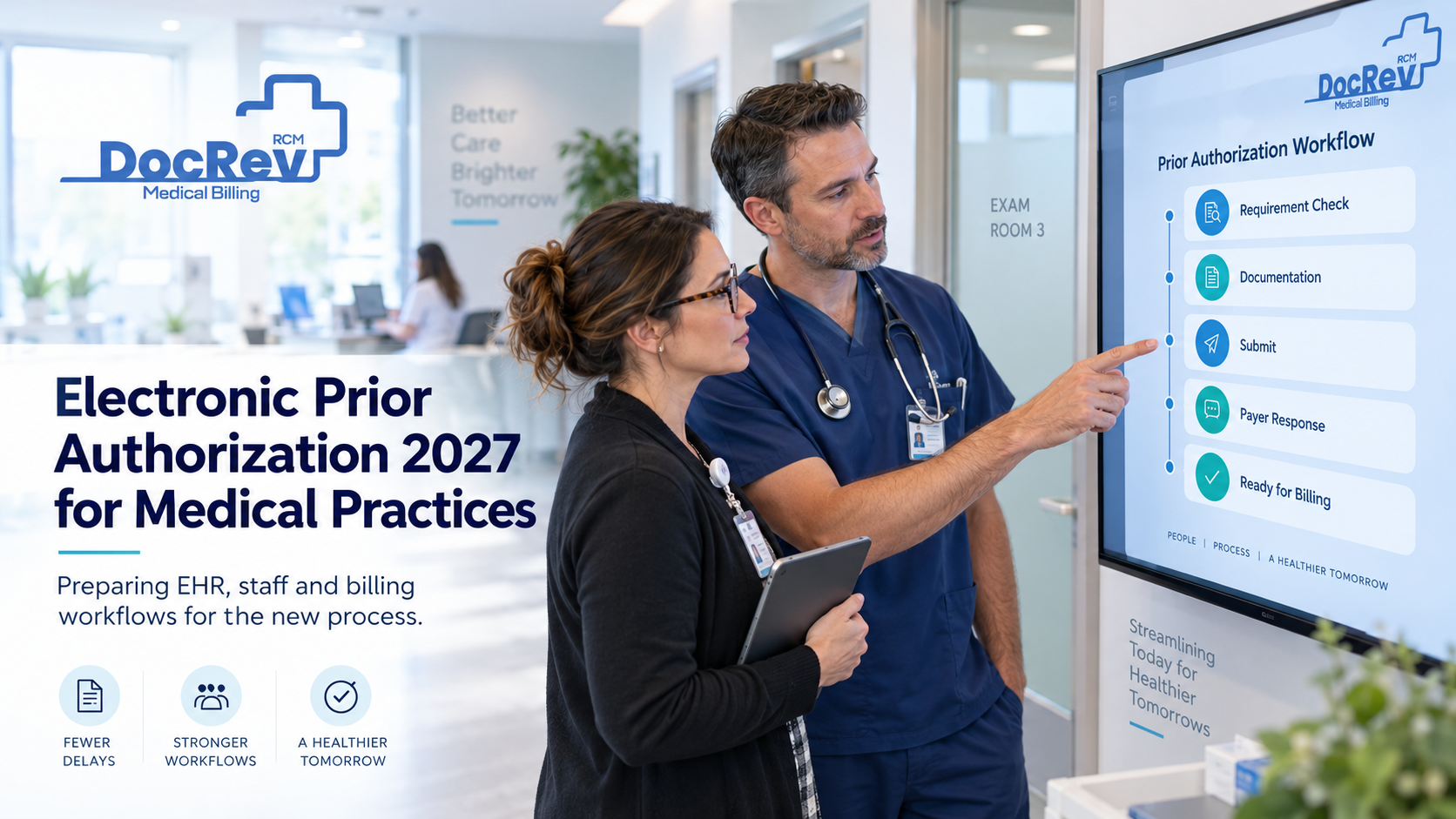
For many medical practices, prior authorization is still handled through a mixture of payer portals, phone calls, faxes, manual follow-up, staff reminders, and information pulled from different parts of the EHR. That familiar process is about to change for a significant part of the healthcare system.
Beginning in 2027, certain health plans regulated by the Centers for Medicare & Medicaid Services will be required to support standardized electronic prior authorization through application programming interfaces, commonly called APIs. The goal is to make it easier for provider systems to determine whether authorization is required, understand documentation requirements, submit requests, and receive payer responses electronically.
For medical practices, however, the practical issue is not the technology by itself. The real question is how these changes will affect the people who schedule services, verify insurance, gather documentation, submit authorization requests, monitor responses, prepare claims, and deal with denials when something does not go as expected.
That makes electronic prior authorization a revenue-cycle issue as much as a technology issue.
A practice can have a technically capable EHR and still struggle if staff do not know where authorization work belongs in the workflow. A payer can make electronic functionality available, but the practice still needs accurate patient information, appropriate clinical documentation, clear staff responsibilities, and a billing process that understands what happened before the claim is submitted.
For physicians, practice administrators, and revenue-cycle leaders preparing for 2027, now is the time to understand what is changing, what is not changing, and where the current workflow may need attention.
What Is Changing With Electronic Prior Authorization in 2027?
The 2024 CMS Interoperability and Prior Authorization Final Rule requires certain impacted payers to implement and maintain a Prior Authorization API as part of a broader set of healthcare interoperability requirements.
The affected payer categories include Medicare Advantage organizations, state Medicaid and CHIP fee-for-service programs, Medicaid managed care plans, CHIP managed care entities, and Qualified Health Plan issuers on the Federally Facilitated Exchanges, although the exact compliance date can vary by payer type.
CMS describes the Prior Authorization API as a way for provider systems to electronically access information needed during the prior authorization process. The API is expected to identify whether prior authorization is required for covered items and services, communicate documentation requirements, support submission of authorization requests, and return payer responses.
Those responses may include an approval, a denial with a specific reason, or a request for additional information.
The finalized 2027 requirements apply to prior authorization for medical items and services covered by the rule and exclude drugs. CMS has separately proposed additional electronic prior authorization requirements involving certain drugs, but those proposals should not be confused with the requirements already finalized under CMS-0057-F.
Practices that want the official technical and regulatory details should review the current CMS electronic prior authorization guidance as implementation approaches.
Why Medical Practices Should Prepare Before January 2027
January may sound far enough away to delay preparation, but electronic prior authorization depends on more than the payer turning on an API.
The practice also needs to understand whether its EHR or other technology can connect with the payer functionality, what updates or modules may be required, how authorization work will appear inside the workflow, and which staff members will be responsible for each stage.
CMS is already encouraging providers to speak with their EHR vendors about implementation timelines, integration capabilities, certification, testing opportunities, staff training, and technical support.
That is a useful place for every practice to begin.
The question for a practice administrator should not simply be, “Will our EHR support electronic prior authorization?”
The better question is, “What will the actual workflow look like in our practice when it does?”
Someone still needs to initiate the process. Someone may need to gather clinical information. Someone needs to respond when the payer asks for more documentation. Someone needs to know when authorization has been approved, denied, or remains unresolved. And the billing team needs reliable visibility into that outcome before a claim is sent.
Technology can simplify movement between these steps, but it does not eliminate the need for ownership.
Electronic Prior Authorization Does Not Eliminate the Need for Eligibility Verification
One of the easiest mistakes practices can make is assuming that electronic prior authorization will replace other front-end revenue-cycle work.
It will not.
Eligibility verification and prior authorization solve different problems.
Eligibility verification helps the practice understand whether the patient's coverage is active and what available benefit information applies. Depending on the payer and plan, that process can also help identify whether referral or prior authorization requirements may exist.
Prior authorization is the separate process through which the payer evaluates a request for a service or item that requires advance approval.
DocRev's insurance eligibility verification services already distinguish between these two functions. Eligibility verification can identify available authorization requirements for practice staff, but the authorization itself remains a separate payer process.
That distinction will still matter in 2027.
An electronic authorization workflow is only useful when the practice begins with accurate insurance information. If coverage has changed, payer information is outdated, or the wrong plan is selected, the authorization process can begin from the wrong starting point.
Electronic connectivity therefore makes good front-end information more important, not less important.
The New Workflow Starts With the EHR
CMS is specifically telling providers to talk with their EHR vendors before the 2027 implementation period.
That advice deserves attention because the user experience will depend heavily on how each technology vendor implements the new capabilities.
Some practices may eventually access authorization requirements directly within familiar clinical or administrative screens. Others may use integrated modules or connected applications. The exact workflow will depend on the systems, payer connections, and implementation choices available to the practice.
Before assuming the transition will be automatic, medical practices should understand what their current vendor actually plans to support.
Administrators should know whether the existing system will require an upgrade, whether electronic prior authorization functionality is included in the current product, whether additional configuration will be required, and what payer connections will be supported.
Testing also matters.
A feature that exists technically is not necessarily ready operationally. Staff need to understand how information moves through the system, where payer responses appear, how additional documentation requests are handled, and what happens when an electronic transaction cannot be completed as expected.
The strongest transition will happen when the technology and workflow are tested together.
Electronic Prior Authorization Is Not the Same as Automatic Approval
Another expectation practices should address early is the idea that electronic authorization means instant approval.
That is not what the CMS rule promises.
The API is intended to make the process more standardized and electronic, but the payer still evaluates the request according to applicable coverage requirements and the information submitted.
A payer can approve a request, deny it, or ask for additional information.
That means the quality and completeness of the underlying documentation still matter.
If the payer requires specific clinical information to make a decision, the practice still needs to provide that information. If documentation is incomplete, an electronic connection cannot create missing clinical support on behalf of the provider.
This is a critical point for practice leaders because it separates process efficiency from coverage decisions.
Electronic prior authorization may reduce some of the administrative friction associated with obtaining requirements and exchanging information, but it does not guarantee that every requested service will be authorized.
Prior Authorization Decision Timeframes Have Already Changed
The 2027 API requirements are not the only prior authorization changes practices should understand.
Under the same CMS final rule, certain operational prior authorization requirements began taking effect in 2026 for impacted payers.
CMS states that impacted payers are required to send prior authorization decisions for certain medical items and services within 72 hours for expedited requests and within seven calendar days for standard requests, subject to the applicable requirements of the program and payer involved.
These timing requirements matter because practices should not build their internal workflow around outdated expectations.
When staff know when a payer response should reasonably be expected, unresolved requests can be followed up more intelligently.
That does not mean every authorization request will be complete within the same amount of time. Requests for additional documentation, payer-specific requirements, incomplete information, and other circumstances can affect the process.
The point is that practices should be using current payer and CMS guidance rather than relying only on historical habits.
Staff Roles May Need to Change Even If Headcount Does Not
Electronic prior authorization does not necessarily mean a practice needs a completely new administrative team.
It may, however, change how existing work is divided.
In a manual environment, staff may spend significant time moving between portals, making calls, checking fax responses, or documenting authorization status in separate systems.
As more of the process becomes available electronically, some of that work may shift toward monitoring integrated queues, reviewing requirements, resolving exceptions, providing requested documentation, and ensuring authorization information reaches the correct clinical and billing teams.
That change deserves planning.
Practices should decide who owns the authorization request, who handles requests for additional information, who monitors unresolved cases, who communicates problems to clinical staff, and who confirms that authorization information is available to billing before claim submission.
Without those responsibilities, an electronic workflow can still become fragmented.
The technology may show an authorization response, but if the billing team does not know where to find it or how the practice documents the result, downstream claim problems can still occur.
Prior Authorization Still Needs to Connect With Medical Billing
An approved authorization is not the end of the revenue cycle.
The service still needs to be documented, coded appropriately, prepared for billing, submitted to the correct payer, adjudicated, posted, and followed if it remains unpaid.
This is why prior authorization should never be managed as an isolated front-office task.
If authorization information does not reach the billing workflow, the practice may still encounter claim problems even when approval was obtained before the service.
The billing team needs access to the information required for the claim and follow-up process. That may include the authorization status, applicable reference information, approved service details, dates or circumstances associated with the approval, and other payer-specific information relevant to billing.
DocRev's medical billing services connect front-end information with claim preparation, submission, payment posting, rejection correction, and billing follow-up.
The important operational lesson for 2027 is that electronic prior authorization should improve the handoff into billing rather than become another disconnected system the billing team has to chase.
Authorization Approval Does Not Guarantee Claim Payment
This point should be made clearly to both staff and patients.
Prior authorization approval is not the same as a guarantee that a future claim will be paid.
The final claim still needs to reflect the service that was actually provided, applicable coverage, correct billing information, and other payer requirements.
Patient eligibility can also change between the authorization request and the date the service is performed.
That is why practices should continue to maintain accurate eligibility, documentation, coding, and claim-submission workflows even as prior authorization becomes more electronic.
A practice that treats authorization approval as the final revenue-cycle checkpoint can still end up dealing with denials or unresolved claims later.
Electronic prior authorization should strengthen the front end of the process, but it does not replace the rest of the revenue cycle.
Denied Authorizations and Denied Claims Are Different Problems
Medical practices also need to distinguish between an authorization request that is denied before the service and a medical claim that is denied after the service has been billed.
They occur at different stages and require different responses.
Under the 2027 Prior Authorization API requirements, impacted payers are expected to communicate a specific reason when an authorization request is denied.
That may help practices understand what needs attention earlier in the process.
A claim denial, by comparison, occurs after the payer has adjudicated a submitted claim and determined that it will not be paid as submitted.
Authorization issues can certainly contribute to claim denials, but not every denial is an authorization problem.
When a claim does reach the denial stage, DocRev's medical billing denial management services focus on understanding the payer's denial reason and routing the claim toward the appropriate correction, appeal, or follow-up action.
The more clearly practices separate these stages, the easier it becomes to identify whether a problem originated before treatment, during billing, or after payer adjudication.
Not Every Payer Is Covered by the Same 2027 Requirement
Another area where medical practices need precision is payer scope.
The CMS-0057-F Prior Authorization API requirements do not mean that every insurer in the healthcare system is suddenly subject to one identical 2027 workflow.
The finalized rule applies to specific categories of CMS-regulated payers, including Medicare Advantage organizations, Medicaid and CHIP programs and managed care entities, and Qualified Health Plans offered on the Federally Facilitated Exchanges.
Practices should therefore avoid treating January 1, 2027 as a universal switch that makes every payer operate the same way.
Commercial payer processes outside the rule may differ. State requirements can also matter. Individual plans may implement technology and workflows differently.
For a medical practice, the operational response should be payer-specific readiness rather than one blanket assumption.
The billing and authorization teams should understand which major payers in the practice's actual payer mix are affected and how those payers intend to implement electronic prior authorization.
The 2027 Requirements Generally Exclude Drugs
Practices should also be careful with another distinction that can easily become confusing in articles about 2027.
The finalized Prior Authorization API requirements under CMS-0057-F generally apply to medical items and services and exclude drugs.
CMS has proposed additional interoperability and electronic prior authorization requirements for drugs covered under medical and pharmacy benefits, including proposed 2027 implementation dates.
Those drug-related requirements are part of a proposed rule and should not be described as though they are already finalized.
This distinction matters for specialties that routinely manage prior authorization for medications.
Practice administrators should follow current CMS and payer guidance rather than assuming that every drug authorization will move into the same finalized workflow on January 1.
MIPS Eligible Clinicians Have Another Reason to Pay Attention
CMS is also adding an Electronic Prior Authorization measure to the Health Information Exchange objective within the MIPS Promoting Interoperability performance category.
Beginning with the 2027 performance period, MIPS eligible clinicians subject to the measure are expected to attest to electronically requesting prior authorization through a Prior Authorization API using certified EHR technology for at least one applicable medical item or service, unless an applicable exclusion applies.
Eligible hospitals and critical access hospitals also have related requirements under the Medicare Promoting Interoperability Program.
This does not mean every physician practice in the country has the same reporting obligation.
Practices should determine whether their clinicians participate in MIPS and what reporting requirements apply to them rather than assuming the measure applies universally.
For organizations that are affected, however, this creates another practical reason to understand EHR readiness well before the 2027 reporting period begins.
What Medical Practices Should Be Reviewing Now
A useful readiness review begins with the workflow the practice already has.
Practice leaders should understand how authorization requirements are currently identified, where staff look for payer rules, how clinical documentation is gathered, who submits the request, how payer responses are monitored, and where approval information is stored.
From there, the practice can compare that process with what its EHR vendor and major payers are planning for electronic prior authorization.
The goal is not to rebuild everything simply because a new API becomes available.
The goal is to identify where electronic information can replace unnecessary manual work while preserving the clinical and administrative checks the practice still needs.
Some workflows may become simpler. Others may initially require new training and troubleshooting while staff become familiar with the technology.
The best preparation is practical rather than theoretical.
Staff need to know what screen they will use, what information they need, how they recognize a response, how they escalate exceptions, and how the final authorization status reaches billing.
Do Not Wait Until a Claim Is Denied to Discover the Authorization Workflow Failed
One reason prior authorization deserves attention from revenue-cycle leaders is that a front-end problem can become a back-end billing problem weeks later.
If authorization requirements were not identified, if the request was incomplete, if documentation was missing, or if the authorization result was not captured correctly, the problem may not become financially visible until the claim is processed.
At that point, staff are working backward.
They are trying to reconstruct what happened before the service while also responding to a payer decision after the service.
A stronger process catches authorization issues earlier.
That is where electronic prior authorization has real potential value for practices: not because it eliminates payer requirements, but because it can make those requirements and responses easier to integrate into the workflow when the systems and staff are prepared to use them.
Electronic Prior Authorization Should Strengthen the Revenue Cycle, Not Become Another Silo
Healthcare practices already use multiple systems and workflows to manage scheduling, eligibility, clinical documentation, prior authorization, coding, billing, payments, denials, and accounts receivable.
The value of a new electronic process depends partly on whether it reduces fragmentation or simply adds another place for staff to check.
That is why practices should evaluate electronic prior authorization within the larger revenue cycle management process.
The authorization workflow should connect naturally with eligibility information before the service and with billing information after the service.
If the practice can see those connections clearly, it becomes easier to determine where delays originate and which team needs to respond.
If every function remains isolated, the technology may improve one transaction while the overall revenue cycle remains difficult to manage.
Where Professional Revenue Cycle Support Fits
Electronic prior authorization does not remove the need for strong medical billing operations.
In some practices, it may actually make workflow discipline more important because information will move faster between payers and provider systems.
Professional RCM support can help keep the financial side of the process connected after the authorization stage.
Eligibility information needs to be available before the visit. Billing information needs to be prepared correctly after the encounter. Claims need to be submitted through the appropriate payer workflow. Payments need to be posted. Denials and unpaid balances need follow-up.
No single authorization technology replaces those responsibilities.
DocRev RCM supports medical practices across those connected stages through eligibility verification, medical billing services, denial management, and broader revenue cycle management services.
DocRev does not position itself as an EHR developer or Prior Authorization API vendor. The role of billing and RCM support is different: helping practices keep payer information, claims, denials, payments, and follow-up connected around the clinical workflow the practice already uses.
Preparing Now Gives Practices More Time to Adjust
The most difficult time to discover that an EHR is not ready, staff do not understand the new workflow, or payer connections are unclear is after the implementation period has already begun.
Preparing in advance gives practices time to ask questions without the pressure of an immediate operational problem.
It allows administrators to speak with vendors, understand payer plans, test workflows where available, train staff, define responsibilities, and determine how electronic authorization information will reach the billing process.
Not every practice will make the transition at the same pace.
Not every payer will present the workflow in exactly the same way.
And not every existing manual process will disappear immediately.
But practices that understand their current process before 2027 will be in a much better position to recognize what needs to change once electronic capabilities become available.
Electronic Prior Authorization Is One Part of a Larger Billing Strategy
The 2027 changes are important, but medical practices should resist treating electronic prior authorization as a standalone technology project.
The authorization decision sits between front-end insurance information and downstream billing.
If those connections are strong, electronic prior authorization can support a more organized revenue cycle.
If those connections are weak, a faster authorization transaction may still feed into a fragmented billing process.
The real preparation therefore involves more than turning on an API.
It involves understanding payer requirements, confirming EHR readiness, training staff, clarifying responsibilities, keeping authorization information connected to billing, and maintaining strong follow-up when claims are ultimately processed.
For medical practices reviewing their readiness for 2027, this is a useful time to look at the broader workflow rather than waiting for January.
If your practice is already dealing with fragmented eligibility, authorization, billing, denial, or payer follow-up processes, contact DocRev RCM to discuss how your existing revenue-cycle workflow can be reviewed and supported before the new electronic prior authorization environment takes effect.
Frequently Asked Questions About Electronic Prior Authorization in 2027
What changes for electronic prior authorization in 2027?
Under CMS-0057-F, certain CMS-regulated payers must implement and maintain Prior Authorization APIs beginning in 2027. These APIs are intended to allow provider systems to identify authorization requirements, understand required documentation, submit authorization requests, and receive payer responses electronically for applicable medical items and services.
Does the 2027 electronic prior authorization rule apply to every health insurance company?
No. The CMS final rule applies to specified impacted payers, including Medicare Advantage organizations, certain Medicaid and CHIP programs and plans, and Qualified Health Plan issuers on the Federally Facilitated Exchanges. Practices should review their own payer mix and confirm which payer requirements apply rather than assuming every insurer follows the same rule.
Do medical practices have to replace their EHR for electronic prior authorization?
Not automatically. CMS recommends that practices speak with their existing EHR vendors about implementation timelines, API integration capabilities, certification, upgrades, modules, testing, and staff support. Whether a practice needs additional technology depends on the system it currently uses and how the vendor implements electronic prior authorization functionality.
Will electronic prior authorization guarantee approval?
No. Electronic prior authorization changes how information can be exchanged, but the payer still evaluates the request according to applicable coverage requirements and the information submitted. A payer may approve the request, deny it, or ask for additional information.
Does prior authorization approval guarantee that the medical claim will be paid?
No. Authorization approval does not guarantee final claim payment. The claim still has to reflect the service provided, applicable coverage, correct billing information, and other payer requirements. Eligibility and other circumstances may also change between authorization and the date of service.
Are drugs included in the finalized 2027 Prior Authorization API requirements?
The Prior Authorization API requirements finalized under CMS-0057-F generally address medical items and services and exclude drugs. CMS has separately proposed additional electronic prior authorization requirements involving drugs, but proposed provisions should not be treated as finalized until CMS completes that rulemaking process.
What should medical practices do now to prepare for 2027?
Practices should review their current prior authorization workflow, speak with their EHR vendors about readiness, understand how major payers plan to implement the new functionality, identify which staff will manage the electronic workflow, prepare for training and testing, and make sure authorization results can be communicated clearly to billing and clinical teams.
How does electronic prior authorization connect with medical billing?
Prior authorization occurs before applicable services are billed, but the authorization result can affect downstream claim processing. Billing teams need visibility into relevant authorization information so claims can be prepared and followed appropriately. Electronic prior authorization should therefore be integrated with eligibility, documentation, medical billing, denial management, and other revenue-cycle functions rather than managed as an isolated task.
Will electronic prior authorization reduce claim denials?
Electronic prior authorization may help practices identify requirements and payer responses earlier, but it does not eliminate claim denials. Claims can still encounter problems related to eligibility, documentation, coding, billing information, coverage, and other payer requirements. Practices should continue maintaining a structured denial-management process.
Does DocRev RCM implement Prior Authorization APIs?
DocRev RCM does not position its medical billing services as EHR development or Prior Authorization API implementation. DocRev supports the surrounding revenue-cycle workflow through eligibility verification, medical billing, denial management, and broader RCM services, working within the systems and access available to the practice.