
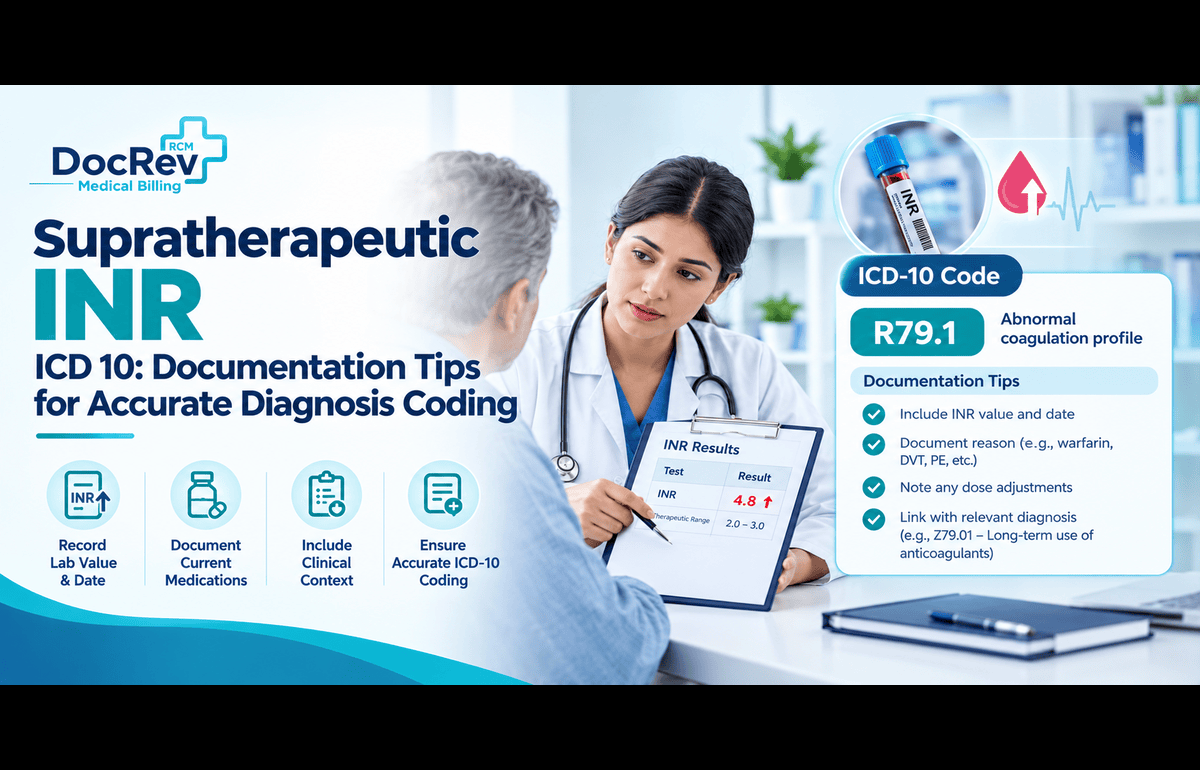
What Is the ICD-10-CM Code for Supratherapeutic INR?
The short answer is R79.1 in most cases. There is no code named "supratherapeutic INR" in ICD-10-CM. Coders use the Supratherapeutic INR ICD 10 code that matches the finding, and that is usually R79.1, Abnormal coagulation profile. Still, R79.1 is only the starting point. Bleeding, medication use, and a confirmed disorder can all change the final choice.
R79.1 — Abnormal Coagulation Profile
R79.1 sits in Chapter 18 of ICD-10-CM, which covers symptoms, signs, and abnormal findings. The code covers abnormal or prolonged prothrombin time (PT), and other abnormal clotting test results. That makes it the usual answer for anyone searching for an ICD 10 code for elevated INR or an ICD 10 code for prolonged PT. If you also see searches for elevated prothrombin time ICD 10, the answer points to the same place, because INR is calculated from the PT.
The code describes a lab finding. It does not describe a disease or a drug problem. Because of that, it works best when the provider notes the result and no bleeding or other diagnosis goes with it. Always read the notes under the code in the Tabular List, including any Excludes notes, before you assign it. People who type R79.1 ICD 10 into a search box usually want the full title, which is Abnormal coagulation profile. Searches for Abnormal coagulation profile ICD 10 and Elevated INR ICD 10 land on the same code, so the answer is the same for all three.
What Does a Supratherapeutic INR Mean?
The International Normalized Ratio (INR) measures how long blood takes to clot. The lab reports it as a standard number, so results can be compared between labs. Patients on warfarin often have a target range, such as 2.0 to 3.0. "Supratherapeutic" means the INR is above the range set for that patient. A high number means the blood is clotting more slowly than planned, which can raise the risk of bleeding.
The word describes a clinical situation, not a code. A provider may use it in a note to say that the dose may need to change. A coder reads that note as part of the clinical findings and then looks for the next piece: is the patient bleeding, and did the provider link the result to a drug?
Why the Correct ICD-10-CM Code Depends on Clinical Documentation
Two patients can have the same INR of 5.2 and need different codes. One has no symptoms, and the provider simply adjusts the dose. The other has blood in the urine, and the provider links it to warfarin. The lab value is the same, but the provider assessment is not. The coder cannot see this difference in the lab report alone. Only a confirmed diagnosis, written in the record, can support a code beyond the finding code. This is why code verification matters. Look up the term in the Alphabetic Index, confirm the code in the Tabular List, and then check it against the provider's words. If the words and the code do not match, the claim is at risk.
How to Choose the Correct ICD-10-CM Code for Elevated INR
Good diagnosis code selection starts with four questions. Is the patient bleeding? Is the patient taking a blood thinner? Did the provider link the result to the drug? Did the provider document a separate clotting disorder? The answers lead you to the right path, and the sections below walk through each one. These steps also match the basic INR coding guidelines that most teams follow.
Elevated INR Without Bleeding
Searches for high INR without bleeding ICD 10 usually end at R79.1. If the patient has a high result, no bleeding, and no confirmed diagnosis, the finding stands on its own. Elevated INR without bleeding is the cleanest case for supratherapeutic INR coding. The provider should still write that the result is clinically relevant, such as "INR 4.8, no bleeding, hold warfarin tonight." That single line shows the finding, the bleeding status, and the plan.
Elevated INR With Documented Bleeding
Bleeding changes the picture. If the provider documents bleeding in a patient on warfarin and links it to the drug, the bleeding is no longer just a lab finding. Anticoagulant-related bleeding ICD 10 coding often points to D68.32, Hemorrhagic disorder due to extrinsic circulating anticoagulants. Coders also report the site of the bleeding when the record gives it, such as blood in the urine or a nosebleed. This is anticoagulant-associated bleeding, and the record must make that link clear. A coder should not assume it from the INR alone.
Elevated INR Due to Warfarin or Another Medication
Many people search for warfarin toxicity ICD 10, but ICD-10-CM does not have a code with that name. The Tabular List asks a different question: was the drug taken as prescribed, or was it taken in error? When a drug is prescribed and taken correctly and still causes a problem, that is an adverse effect, and T45.515- applies. When the wrong dose or the wrong drug was taken, that is a poisoning, and T45.511- may apply instead. The seventh character shows the encounter, so check it too. Many coders also add Z79.01 for long-term use of anticoagulants. Follow the official guidelines and your payer's rules for code sequencing, because the order of these codes matters.
Note that a provider's words matter here as well. A "suspected medication-related complication" is not a confirmed diagnosis in the outpatient setting. Report what is confirmed, and ask for clarification on the rest.
When an Underlying Coagulation Disorder Is Documented
Sometimes the high INR is not caused by a drug. A provider may link it to liver disease, vitamin K deficiency, or another clotting problem. In that case, a code from the coagulation defect group, D65 to D69, may fit better than R79.1. The provider must name the disorder. If the note says only "abnormal INR, cause unclear," stay with the finding code and send a provider query if more detail would change the claim.
Essential Documentation Requirements for Supratherapeutic INR Coding
Good medical coding documentation tips come down to one idea: write what happened, and write why. A coder cannot fill in the blanks. The five items below give any INR note the detail it needs. Use them as a quick documentation review each time.
Document the INR Value and Relevant Laboratory Findings
The note should state the INR value, the date, and the patient's target range. It should also list other relevant labs, such as the PT or a hemoglobin level if bleeding is a concern. A coagulation profile with several values paints a fuller picture than a single number. The exact value also helps show why the provider acted. Many practices keep INR results in a flow sheet or a separate anticoagulation log. If so, the provider's note should still repeat the key value and say where the full log can be found, so the coder does not have to search the whole chart.
Record the Provider's Diagnosis and Clinical Assessment
The provider should say what the result means. Phrases like "supratherapeutic INR due to warfarin" or "elevated INR, no clinical concern" are clear and short. Without this assessment, the coder may only see a lab value, and a lab value alone does not support a diagnosis.
Specify Bleeding Status and Associated Symptoms
Bleeding status is the most important detail in INR diagnosis coding. The note should say "no bleeding" or describe the bleeding, including the site and the severity. It should also list related symptoms, such as bruising, dark stools, or dizziness. A missing statement leaves the coder unsure, and unsure coders either guess or query.
Document Anticoagulant Use and Any Confirmed Medication-Related Complication
The record should name the drug, the dose, and the reason for use, such as atrial fibrillation. If the provider confirms that the drug caused a problem, the note should say so in plain words. It should also say whether the patient took the drug as prescribed. That detail decides between an adverse effect and a poisoning code. Do not leave it for the coder to infer.
Include the Treatment Plan and Follow-Up When Relevant
A plan shows medical necessity. The note might say to hold a dose, lower the dose, give vitamin K, or repeat the INR in two days. Even a simple "recheck in one week" tells the payer that the result led to action. It also supports any repeat tests billed later.
Common Documentation Gaps That Lead to Coding Errors
Most ICD 10 coding errors with INR results are not caused by weak coding skills. They come from gaps in the record. Four gaps appear again and again, and a coding audit will often find them.
Reporting an Abnormal INR Without Reviewing the Provider's Assessment
Some coders see a flagged INR and assign R79.1 at once. But the provider may have written that the result was expected, or that a bleeding event explains it. Reporting the finding without reading the note can create a claim that does not match the chart. Always read the assessment first.
Confusing an Elevated INR With a Confirmed Hemorrhagic Disorder
A high INR is a lab result. A hemorrhagic disorder is a diagnosis. The first does not prove the second. Without bleeding and without a provider's diagnosis, a code such as D68.32 has no support. Using it anyway can lead to an audit finding and a claim denial.
Missing Documentation of a Medication-Related Complication
The opposite error also happens. The patient is bleeding on warfarin, and the note never links the two. The coder reports only the bleeding site and misses the drug-related code. The claim then understates what happened. A short provider query can fix this before the claim leaves the office.
Using an Unsupported or Outdated ICD-10-CM Code
The code set changes every year on October 1. A code that was valid last year may be changed or deleted this year. Coders who rely on old cheat sheets, or on a website that is not kept current, may submit codes that do not match the date of service. Verify the code in the current ICD-10-CM resources every time, and check the date of service before you submit.
Supratherapeutic INR ICD-10 Coding Examples
These four cases use made-up patients. They are simplified to show the thinking, not to replace the official guidelines. Always confirm each code in the current ICD-10-CM resources and follow your payer's rules.
Example 1: Elevated INR Without Documented Bleeding
A 72-year-old patient takes warfarin for atrial fibrillation. At a routine check, the INR is 4.9. The provider writes, "Supratherapeutic INR, no bleeding. Lower the weekly dose. Recheck in one week." The finding is clear, the bleeding status is clear, and the plan is clear. R79.1 fits the result. Where the provider links the result to warfarin taken as prescribed, coders may also report the adverse effect code T45.515A and Z79.01 for long-term use.
Example 2: Elevated INR With Documented Bleeding
A patient on warfarin walks into an urgent care center with blood in the urine. The INR is 6.1. The provider writes, "Hematuria due to warfarin, INR supratherapeutic. Hold warfarin and give vitamin K." Now the bleeding is documented and linked to the drug. D68.32 may apply, along with the code for the bleeding site and T45.515A. Busy sites that rely on urgent care rcm services see this kind of case often, and the link between the bleeding and the drug must be in the note.
Example 3: Elevated INR With a Documented Medication-Related Complication
A patient mistakenly takes a double dose of warfarin for three days. The INR is 8.2, and the patient has no bleeding. The provider documents the dosing error and the high INR. Because the drug was not taken as prescribed, the coder should check the poisoning rules, where T45.511A may apply, instead of the adverse effect rules. Sequencing is different for poisoning, so read the guideline notes before you submit.
Example 4: Incomplete Documentation Requiring Provider Clarification
A note reads, "INR 5.5. Possible GI bleed. Hold warfarin." The note does not confirm bleeding, and there is no documented link to the drug. In an outpatient setting, "possible" cannot be coded as a diagnosis. The coder can report the finding, R79.1, and any confirmed symptoms. A provider query should ask whether bleeding was confirmed and whether it was caused by warfarin. The answer may change the code and the payment.
| Scenario | Likely starting point | What the note must show |
|---|---|---|
| High INR, no bleeding | R79.1 | Value, bleeding status, plan |
| High INR with bleeding on warfarin | D68.32 plus bleeding site code | Bleeding site and link to the drug |
| Extra dose taken in error | Poisoning rules, T45.511A | Dosing error and result |
| Possible bleeding, not confirmed | R79.1 plus confirmed symptoms | Provider clarification |
How Accurate INR Documentation Supports Medical Billing
Clean notes help the whole medical billing process. When the record is clear, the coder works faster, the claim goes out right, and the payer has fewer reasons to push back.
Improving Diagnosis-Code Accuracy
Claim accuracy begins with the diagnosis code. If the note shows the INR, the bleeding status, and the drug link, the coder can choose the right code on the first try. That cuts the number of corrections and the number of claims that sit in a queue waiting for an answer. A simple example shows the gain. If the coder must call the provider on every INR claim, each claim may sit for days. If the note already covers the value, the bleeding status, and the drug link, the same claim can go out the same day. Over a month, that saves many hours and speeds up payment.
Reducing Coding-Related Claim Denials
Payers deny claims when the diagnosis does not match the service. A code that points to bleeding without a bleeding note is a common trigger. So is a code that ignores a documented drug event. Practices that outsource family medicine billing services often manage many anticoagulation patients, and small gaps in INR notes can repeat across hundreds of claims. At DocRev RCM, our denial management work looks for those repeat patterns, and our managed accounts reach 99% first-pass claim acceptance.
Supporting Medical Necessity and Audit Readiness
A repeat INR test, a dose change, or a follow-up visit all need a reason. The high result, with the provider's plan, is that reason. If an auditor asks for the chart, the note should show why each service happened. A regular medical billing audit can find weak INR documentation before a payer does.
Best Practices for Accurate Supratherapeutic INR Diagnosis Coding
Three habits will prevent most of the problems in this guide. They are easy to teach, and they work for new and experienced coders alike.
Follow Current ICD-10-CM Coding Guidelines
The official guidelines explain how to report findings, adverse effects, and poisonings. They also explain how to order the codes. Read them at the start of each fiscal year, since changes take effect on October 1. Keep a short internal note on how your team handles INR cases, so everyone follows the same rules. Include examples of well-written notes, and share them with providers during training. Providers often want to help, but they may not know which details matter for coding. A short checklist at the point of care can close many gaps before the coder ever sees the chart.
Query the Provider When Documentation Is Incomplete or Conflicting
If the note is unclear, ask. A good question is short, neutral, and based on facts. For example: "The INR is 5.5 and the plan says hold warfarin. Please document whether bleeding is present and whether the result is related to warfarin." Do not suggest an answer. Keep a record of each query and reply, so the file is complete if a payer asks for it.
Verify Code Specificity Before Claim Submission
Coding specificity means choosing the most detailed code the note supports, including the seventh character on drug codes. Before you submit, confirm the code in the Tabular List, check any Excludes notes, and check the order of the codes. This last pass takes a few minutes and catches many of the ICD 10 coding errors that would otherwise reach the payer.
Frequently Asked Questions About Supratherapeutic INR ICD 10
What Is the ICD-10-CM Code for Supratherapeutic INR?
The usual code is R79.1, Abnormal coagulation profile. ICD-10-CM has no code with the exact words "supratherapeutic INR." If the provider documents bleeding, a drug adverse effect, a poisoning, or a clotting disorder, other codes may apply too. Confirm each code in the current Tabular List.
Is R79.1 Used for Elevated INR Without Bleeding?
Yes, R79.1 is the common choice for an elevated INR when no bleeding or other diagnosis is documented. The provider should still state that the result matters and say what was done. If the provider links the result to a drug taken as prescribed, additional codes may be reported.
Does an Elevated INR Always Indicate a Bleeding Disorder?
No. A high INR is a lab result, and it can occur in patients who take warfarin as planned. A bleeding or hemorrhagic disorder code needs a provider's diagnosis. Without bleeding and without a confirmed diagnosis, the finding code is usually the better fit.
What Documentation Is Needed for Accurate INR Coding?
The note should show the INR value and target range, the provider's assessment, the bleeding status, the drug name and dose, and the plan. If a complication is confirmed, the note should say so plainly and say whether the drug was taken as prescribed.
When Should a Medical Coder Query the Provider?
Query when the note leaves out a detail that would change the code or the payment. Common examples include unclear bleeding status, a missing link between a bleed and a drug, conflicting statements, or a suspected complication that was never confirmed.
Conclusion
Supratherapeutic INR ICD 10 coding depends on one thing above all: what the provider writes. R79.1 is the usual code for an elevated INR with no bleeding. Bleeding, a drug adverse effect, a poisoning, or a clotting disorder can all lead to different codes. A coder can only choose among them when the note is clear. The habits are simple. Read the full note. Confirm bleeding status. Check how the drug was taken. Verify the code and its order. Query the provider when a gap would change the claim.
If INR-related denials are slowing your revenue, DocRev RCM can help. We provide medical billing, denial management, and medical billing audit support, with fees starting from 3% of collections. Ask for a free RCM assessment by calling +1 814-554-5350 or emailing info@docrevrcm.com, and we will show you where your claims are losing money.