
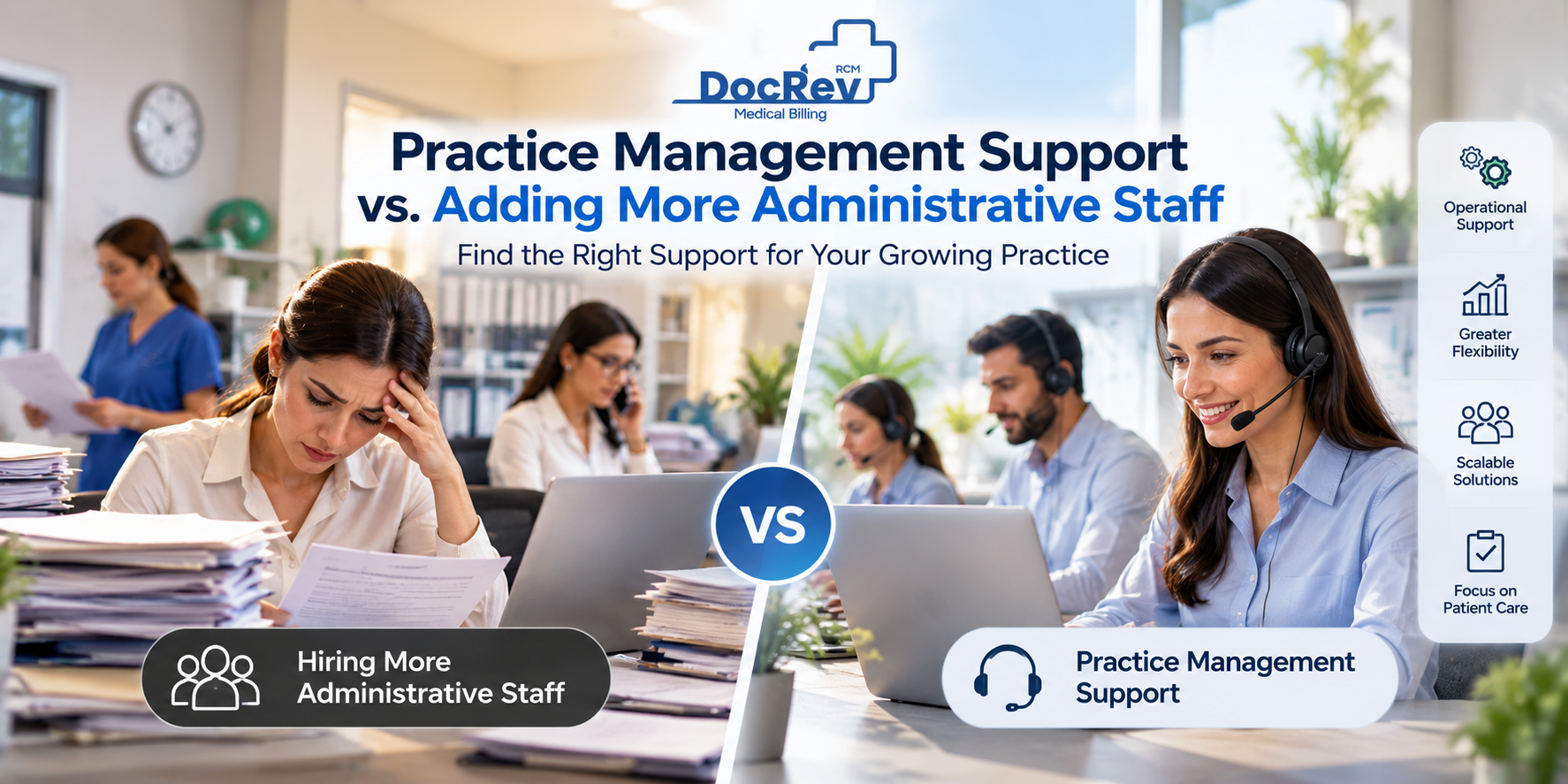
Growing a medical practice usually brings more than additional patients. As the practice becomes busier, administrative responsibilities grow with it. Scheduling becomes more demanding, staff communication becomes more important, daily workflows become harder to coordinate, and physicians can find themselves spending more time managing the business side of the practice instead of focusing on patient care.
At some point, practice owners often face an important decision. Should the practice hire another administrative employee, or would it make more sense to bring in professional practice management support?
There is no single answer that works for every healthcare organization. The right choice depends on the practice's size, workload, operational structure, growth plans, internal capabilities, and the type of support it actually needs.
What matters is understanding the difference between simply adding another person to the payroll and bringing in an external team that is specifically designed to support practice operations.
For growing healthcare organizations, DocRev RCM's Practice Management Support provides additional operational support for clinical and administrative teams while helping practices maintain visibility into important workflows. The service is designed to complement the practice rather than replace the clinical team.
Why Administrative Work Becomes More Difficult as a Practice Grows
A medical practice can operate efficiently when its patient volume and administrative workload remain manageable. Staff members know their responsibilities, communication is relatively simple, and physicians can stay informed about what is happening around the practice.
Growth can change that balance.
More patients can mean more scheduling activity, more communication, more records to manage, more coordination between staff members, and more operational decisions throughout the day. Adding providers or locations can create another layer of complexity because information and responsibilities need to move between more people.
The problem is not always that employees are doing their jobs poorly. In many cases, the problem is simply that the workload has grown beyond the capacity of the existing structure.
When that happens, practice leaders need to determine whether the answer is another internal employee, outside operational support, or a combination of both.
What Does Adding More Administrative Staff Mean?
Hiring another administrative employee gives a practice additional internal capacity. The new employee becomes part of the organization's existing team and can be assigned responsibilities according to the practice's needs.
This can work well when the practice has a clearly defined role that needs to be filled on a continuing basis. A full-time employee may be appropriate when the workload is predictable, the practice has enough work to support the position, and management has the resources to recruit, train, supervise, and retain that employee.
An internal employee can also become deeply familiar with the practice. Over time, that familiarity can be valuable because the person understands the physicians, staff, patients, routines, communication preferences, and internal procedures.
However, hiring also creates a broader management responsibility. The practice needs to recruit the right person, provide training, establish expectations, manage performance, handle absences, and maintain coverage when the employee is unavailable.
For some practices, that is exactly what they want. For others, the additional management responsibility may be the reason they are looking for another approach.
What Is Practice Management Support?
Practice management support provides additional operational assistance without requiring the practice to build every administrative function internally.
The exact scope can vary depending on the needs of the practice. Support may be designed around specific operational responsibilities, ongoing administrative coordination, workflow assistance, or other areas where the practice needs additional capacity.
The important distinction is that practice management support is not simply another employee performing one isolated task. It can provide access to an organized support structure that works alongside the practice's existing clinical and administrative teams.
For DocRev RCM, Practice Management Support is positioned as additional operational support for clinical and administrative teams while maintaining visibility into critical practice workflows. :chatgpt-content-reference{index="2"}
This makes the service particularly relevant for practices that have capable internal staff but need additional support as their workload grows.
Internal Staff and External Support Solve Different Problems
It is easy to compare an employee and an outsourced service simply by looking at cost. That can be misleading because the two models solve different operational problems.
An employee becomes part of the internal organization and normally works according to a defined role and schedule. External support can provide additional capacity without requiring the practice to create another permanent internal position.
The question therefore should not simply be, “Which one costs less?” A more useful question is, “What kind of operational capacity does the practice actually need?”
If the practice needs one person performing a predictable internal role every day, hiring may make sense. If the practice needs additional operational support across several areas or wants flexibility as its needs change, an external support model may be worth considering.
This distinction becomes particularly important for growing practices that are not yet ready to build a larger administrative department.
When Hiring Another Administrative Employee Makes Sense
There are situations where adding an internal employee is a practical decision.
A practice may have a consistent workload that requires dedicated daily attention. The responsibilities may be clearly defined, the volume may justify a permanent position, and the practice may have the management structure required to support another employee.
An internal hire can also make sense when the practice wants someone physically present and closely involved with day-to-day operations. Some practices place significant value on having administrative employees working directly alongside physicians and other staff.
Internal hiring can also provide long-term continuity when a role is expected to remain important as the practice grows.
The important point is that hiring should be based on an actual operational need rather than simply adding another employee because the existing team feels overwhelmed.
When Practice Management Support May Make More Sense
External practice management support can be useful when the practice needs additional capacity but does not necessarily need another permanent internal position.
This can happen when administrative responsibilities fluctuate, when the practice is growing faster than its internal structure, or when existing employees are spending too much time coordinating operational tasks that could be handled with additional support.
It can also be useful when practice leadership needs more operational assistance but does not want to take on the full responsibility of recruiting, training, and managing another administrative employee.
For physician-owned practices, this can be particularly important because the physician may already be balancing patient care with business responsibilities. Additional operational support can give practice leadership more room to focus on decisions that require their direct involvement.
The Cost of an Employee Is More Than a Salary
When a practice considers hiring, salary is naturally one of the first numbers considered. But the actual cost of an employee extends beyond salary alone.
Recruitment requires time. Training requires time. Management requires time. The practice may also need to account for benefits, payroll-related expenses, equipment, workspace, software access, leave coverage, and other employment-related costs depending on the position and employment arrangement.
None of this means hiring is a bad decision. It simply means practice leaders should evaluate the complete operational commitment rather than comparing an external service fee only with an employee's base salary.
Professional practice management support can offer a different cost structure because the practice is purchasing an agreed level of operational support rather than creating another traditional internal position.
The financial comparison should therefore consider the actual responsibilities being supported and the management capacity required under each model.
The Management Responsibility Behind Internal Hiring
An employee does not become productive simply because the practice fills the position.
New staff need onboarding, training, direction, feedback, and ongoing management. Someone inside the practice has to explain procedures, review performance, answer questions, resolve problems, and make sure responsibilities remain covered.
For a larger healthcare organization with an established management structure, this may be straightforward. For a small or growing practice, the responsibility may fall directly on the physician, practice owner, or office manager.
That can create an unexpected problem. The practice hires another person to reduce administrative pressure, but the physician or manager then has additional management responsibilities.
External practice management support can approach the problem differently by providing an established support structure rather than requiring the practice to manage every aspect of another administrative position itself.
Scalability Is an Important Difference
Practice workload does not always grow in a straight line.
A practice may experience periods of rapid growth followed by more stable periods. A new provider may join the organization, a location may open, or patient volume may change. Administrative needs can therefore increase or decrease over time.
A permanent employee may remain appropriate even when workload changes, but the practice needs to consider whether the role will remain fully utilized.
External practice management support can provide another option for practices that want additional capacity without immediately committing to a larger internal structure.
The appropriate model depends on the relationship between workload and long-term business needs. A practice should not outsource every function simply because it can, just as it should not hire internally simply because the workload has increased temporarily.
Operational Continuity Matters More Than One Extra Person
Adding an employee does not automatically solve an operational problem.
If a practice has unclear procedures, inconsistent communication, duplicated responsibilities, or workflows that depend too heavily on individual memory, adding another person can sometimes make the structure more complicated.
Before deciding to hire, practice leadership should understand what is actually causing the workload problem.
Is the practice short on people, or is the existing process inefficient? Are responsibilities clearly assigned? Does staff communication work well? Are important tasks dependent on one person? Can the current workflow handle additional providers and patients?
These questions matter because a staffing problem and a workflow problem are not always the same thing.
Practice management support can be useful when the practice needs assistance with operational capacity and coordination, but the underlying workflow should still be understood and organized.
Internal Employees Can Provide Strong Practice Familiarity
One of the strongest advantages of an internal employee is familiarity.
An employee who works with the practice every day can become highly familiar with its physicians, staff, patients, routines, preferences, and internal communication style.
That knowledge can become valuable over time. The employee may know how a physician prefers information presented, how the front desk handles certain situations, and how different departments communicate with one another.
For some practices, that level of internal familiarity is an important reason to maintain certain administrative functions inside the organization.
The decision to use external support should therefore consider which responsibilities truly benefit from having a dedicated internal person and which responsibilities can be supported effectively through an external operational team.
External Support Can Add Specialized Operational Capacity
External practice management support can provide a practice with access to people and processes focused on operational assistance without requiring the practice to build the entire support structure internally.
This can be useful when the practice leadership understands that it needs more administrative capacity but does not want to spend its time recruiting, training, and managing another employee for every operational need.
The external team can work alongside the practice according to the agreed responsibilities and workflow. This allows the practice to maintain its own leadership structure while receiving additional operational support where it is needed.
The key is establishing clear responsibilities from the beginning. The practice should understand what the support team handles, what remains with internal staff, how communication works, and how performance or workflow issues are addressed.
Practice Growth Changes the Staffing Decision
A staffing model that works for a small practice may not work as the organization grows.
When a practice has one physician and a small administrative team, responsibilities can sometimes be handled informally. As more physicians join, patient volume increases, or additional locations are added, informal processes can become harder to maintain.
At that stage, practice leadership may need to formalize responsibilities and decide which functions should remain internal and where outside support could provide additional capacity.
This is where practice management becomes more than simply having enough employees. It becomes a question of how the entire operation is structured.
External support can be part of that structure when it gives the practice access to operational capacity without requiring immediate expansion of its internal administrative organization.
What Practice Leaders Should Evaluate Before Choosing a Model
Before hiring another employee or bringing in external support, practice leaders should first understand the actual workload.
The practice should identify which responsibilities are consuming the most time, where delays are occurring, which tasks require specialized knowledge, and which activities are directly affecting the ability of the practice to operate smoothly.
It is also important to consider whether the workload is permanent or temporary. A short-term increase in administrative work may not justify creating a permanent position, while a predictable long-term workload may make an internal employee more appropriate.
Management capacity should also be considered. Someone will need to supervise an employee, establish expectations, monitor performance, and provide ongoing support. If practice leadership does not have the capacity to take on those responsibilities, an external support model may deserve consideration.
Finally, the practice should consider growth. The best solution today should not create a problem six months from now when patient volume, staffing, or operational complexity changes.
Practice Management Support Does Not Mean Giving Up Control
Some practice owners hesitate to consider outside support because they believe outsourcing means losing control over their operation.
That does not have to be the case.
A professional support arrangement should have clear responsibilities, communication channels, reporting expectations, and boundaries. The practice remains responsible for its leadership and clinical decisions, while the support team handles the operational responsibilities assigned to it.
The practice should know what is being handled, who is responsible, how information is communicated, and how issues are escalated.
In this model, external support becomes an extension of the practice's operational capacity rather than a replacement for practice leadership.
How DocRev RCM Approaches Practice Management Support
DocRev RCM provides Practice Management Support as part of its broader services for healthcare practices. The service is designed to give clinical and administrative teams additional operational support while maintaining visibility into critical practice workflows. :chatgpt-content-reference{index="3"}
The purpose is not to force every practice into the same operating model. Different practices have different structures, staffing levels, specialties, and operational needs.
For some practices, the support may complement an existing internal administrative team. For others, it may provide additional capacity in areas where internal staff are stretched too thin.
This flexibility allows the practice to maintain its own leadership and clinical structure while receiving operational support where it is most useful.
DocRev RCM also provides medical billing services and broader revenue cycle management support. However, this article's focus is specifically on practice operations and administrative capacity rather than replacing the billing discussion already covered elsewhere on the site.
Choosing the Right Approach for Your Medical Practice
There is no universal answer to whether a medical practice should hire another administrative employee or use practice management support.
An internal employee may be the right choice when the practice has a stable long-term workload, needs someone closely integrated into the organization, and has the management capacity to support another position.
Practice management support may be a better fit when the organization needs additional operational capacity, wants flexibility, or does not want to take on the full responsibility of recruiting and managing another administrative position.
Some practices may also find that a combination works best. Certain responsibilities can remain with internal employees while outside support is used to provide additional capacity in selected operational areas.
The important thing is to make the decision based on the practice's actual workload and growth plans rather than assuming that one model is always better than the other.
When Additional Support Can Help a Growing Practice
If physicians are spending increasing amounts of time dealing with administrative issues, if office managers are consistently overloaded, or if important operational tasks are being delayed because there are not enough people to handle them, it may be time to review the practice's support structure.
The answer may be another employee. It may be better workflow design. It may be professional practice management support. In some situations, it may be a combination of all three.
What matters is identifying the source of the pressure before deciding how to solve it.
A growing healthcare practice needs an administrative structure that can grow with it. If every increase in patient volume requires the physician to personally absorb more administrative responsibility, the practice may eventually reach a point where that model becomes difficult to maintain.
Additional operational support can give practice leadership more room to focus on patient care, staff leadership, and the long-term direction of the organization.
Final Thoughts on Practice Management Support
Adding another administrative employee and using professional practice management support are two different approaches to solving an operational capacity problem.
Hiring internally gives a practice a dedicated member of its own team and can work particularly well when the role is clearly defined and the workload is stable. External practice management support provides another option for practices that need additional operational capacity without necessarily building another permanent internal position.
The right choice depends on the practice's size, workload, management structure, growth plans, and the responsibilities that need support.
For physician-led practices, the most important goal is not simply having more people. It is building an operational structure that allows the clinical team to focus on patient care while administrative responsibilities are handled consistently.
DocRev RCM provides Practice Management Support for healthcare practices that need additional operational assistance while maintaining visibility into important workflows. If your practice is growing and your current administrative structure is becoming difficult to manage, reviewing the available support options can help you determine what approach fits your organization.
Frequently Asked Questions
What is practice management support?
Practice management support provides additional operational assistance to healthcare practices in areas where clinical and administrative teams need more capacity. The exact responsibilities depend on the practice's needs and the scope of the support arrangement.
Is practice management support the same as medical billing?
No. Medical billing focuses specifically on the financial process associated with healthcare services, while practice management support can address broader operational and administrative needs. A practice may use either service independently or combine different forms of support depending on its requirements.
Should a medical practice hire more administrative staff or use outside support?
The right choice depends on the practice's workload, growth plans, management capacity, and the type of responsibilities that need support. An internal employee may be appropriate for a stable long-term role, while external support can provide additional capacity without creating another permanent administrative position.
Can practice management support work alongside an existing administrative team?
Yes. External practice management support can complement an existing internal team. The practice and support provider should establish clear responsibilities so everyone understands which tasks remain internal and which responsibilities are handled externally.
Does outsourcing practice management mean losing control of the practice?
No. A properly structured support arrangement should establish clear responsibilities, communication procedures, reporting expectations, and escalation processes. Practice leadership remains responsible for the organization's decisions while the support team handles the operational responsibilities assigned to it.
When should a growing medical practice consider additional administrative support?
A practice may want to review its administrative structure when staff are consistently overloaded, physicians are spending too much time on operational tasks, important administrative responsibilities are being delayed, or growth is creating more workload than the current team can comfortably manage.
Can a practice use both internal staff and practice management support?
Yes. A practice does not have to choose one model for every responsibility. Some functions may remain with internal employees while external support provides additional capacity in selected operational areas.
Does DocRev RCM provide practice management support?
Yes. DocRev RCM provides Practice Management Support designed to give clinical and administrative teams additional operational support while maintaining visibility into critical practice workflows.
Can practice management support be combined with DocRev RCM's other services?
Yes. DocRev RCM provides Practice Management Support alongside medical billing and other revenue cycle services. A practice can determine which services are appropriate based on its operational and financial needs.
Discuss Your Practice Management Needs With DocRev RCM
If your practice is growing and your internal administrative team is becoming stretched, adding another employee is not the only option. A review of your current workload and workflow can help you determine whether internal hiring, external practice management support, or a combination of both makes sense for your organization.
DocRev RCM can discuss your current operational structure and the areas where your practice needs additional support.
Explore DocRev RCM Practice Management Support or contact DocRev RCM to discuss your practice's needs.