
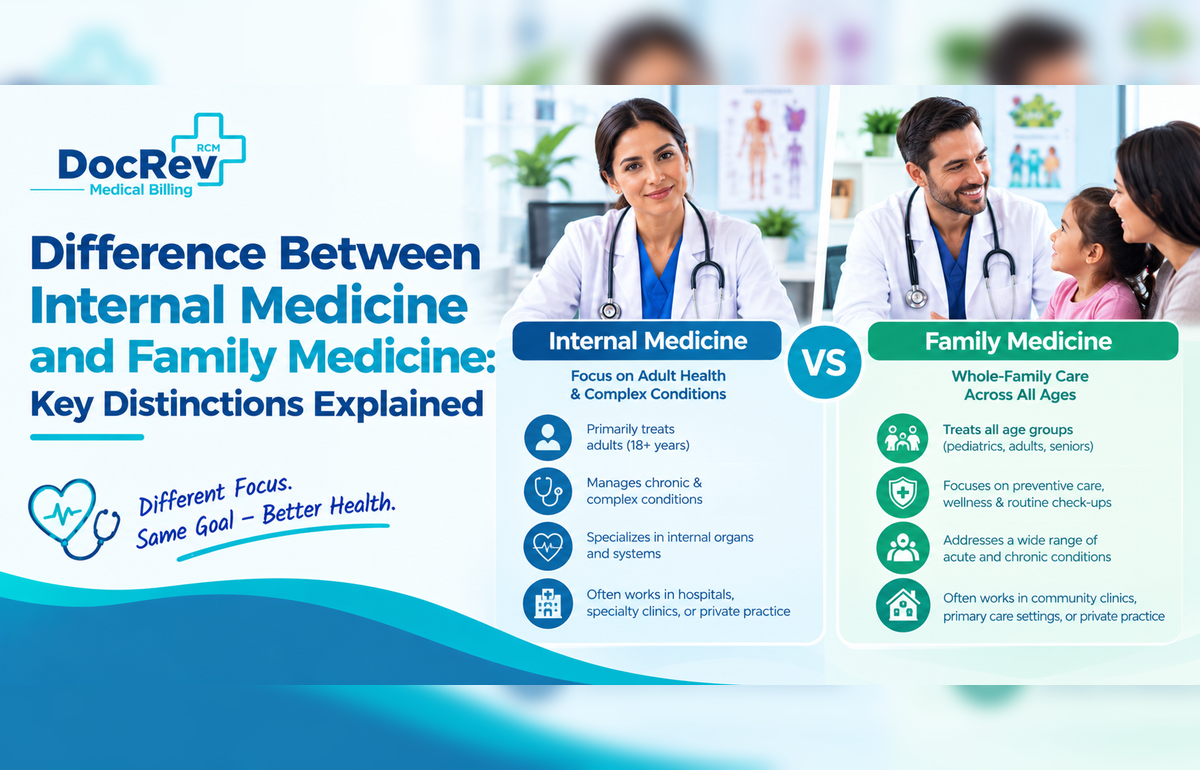
Internal Medicine vs. Family Medicine: The Clinical Differences
Billing teams do not need a medical education, but they do need to know what each specialty is built to do. The American College of Physicians (ACP) publishes a useful comparison of internal medicine and family medicine, and much of this section draws on it.
What Internal Medicine Physicians Do
ACP describes internal medicine physicians as focused on adult patients, meaning age 18 and older. Their training covers common adult conditions and includes significant experience in the internal medicine subspecialties, which prepares them for medically complicated patients. Many internists work in outpatient primary care. Others work in hospitals or complete fellowships in fields such as cardiology. An internist is not an “intern,” which is a physician in the first year of training.
What Family Medicine Physicians Do
The American Academy of Family Physicians (AAFP) defines family medicine as a specialty that provides first-contact, continuous, comprehensive care across the lifespan. ACP notes that family medicine residents must care for a panel of continuity patients, with a minimum number of encounters with children and older adults. Depending on training and the practice, services may also include newborn care, prenatal care, or minor procedures. What a given practice offers varies, and that affects what it bills.
Internal Medicine vs. Family Practice: Is the Terminology Different?
“Family practice” and “family medicine” are commonly used for the same specialty. Medicare’s provider specialty list uses the name Family Practice (code 08) and Internal Medicine (code 11), so billing staff will see both phrases in enrollment and claims work.
| Feature | Internal Medicine | Family Medicine / Family Practice |
|---|---|---|
| Patient age groups | Adults (18 and older) | All ages, from newborns to older adults |
| Basic residency length | Three years | Three years |
| Training emphasis | Adult medicine, with significant subspecialty and hospital experience | Broader scope, including pediatrics and obstetrics, with an emphasis on outpatient and preventive care |
| Pediatric care | Not typical | Yes |
| Chronic disease management | Central to adult primary care | Central to primary care at every age |
| Medicare specialty code | 11 | 08 |
The two overlap more than the table suggests. ACP points out that many patients seen by family physicians are also adults, so adult care is a shared space. For billing purposes, the clinical differences are best treated as tendencies that shape a practice’s patient mix, not as hard rules about what each doctor does.
How Patient Demographics Shape Claims and Billing Workflows
The clinical scope shapes the claims that leave the office. Three effects show up most often.
- Age drives code selection. Preventive medicine visits are reported with an age-based code family: 99381–99387 for new patients and 99391–99397 for established patients, chosen by the patient’s age and status. A family practice works across every age band. An adult-only practice uses the adult bands.
- Coverage rules differ by age and program. Children may be covered under a parent’s commercial plan or Medicaid, while many older adults are on Medicare or a Medicare Advantage plan. Each has its own preventive, vaccine, and authorization rules.
- Account structure differs. A family practice may bill several members of one household under different plans, so a single missed coverage change can affect more than one account.
Illustrative scenario. An internal medicine practice sees mostly adults aged 55 and older. Its biggest billing workload is documenting complex visits and tracking chronic care coordination. A family practice in the same town sees infants, teenagers, and parents. Its biggest workload is matching preventive services and vaccines to each patient’s age and plan. Both submit office visit claims. The pressure points are different.
What Internal Medicine and Family Practice Billing Have in Common
Who Sets the Rules: CPT, Medicare, and Commercial Payers
Three layers of rules apply, and mixing them up is a common source of errors.
- CPT, maintained by the American Medical Association, defines the codes, descriptors, and general guidelines.
- Medicare decides what it covers and how it pays, including its own HCPCS codes (the G-codes) and Medicare Administrative Contractor (MAC) policies.
- Commercial and Medicaid payers set their own coverage and reimbursement policies. They may recognize a code, apply a modifier, or limit frequency differently than Medicare does.
When this article describes Medicare rules, it says so. Always confirm requirements with the specific payer.
Office Visit Coding by Medical Decision Making or Time
Both specialties commonly report office and outpatient visits with codes 99202–99215. Under Medicare guidance in effect since January 1, 2021, the level of service may be selected by medical decision making or total time. Code definitions do not change by specialty. What changes is how often each practice faces complex, multi-problem visits versus short, single-problem or preventive visits.
Because the level depends on the note, not on the number of diagnoses listed, a periodic medical billing audit can show whether documentation supports the levels being billed, in either direction. Overcoding and undercoding are both risks.
Specialty Codes and Enrollment Records
Medicare assigns specialty codes such as 01 (General Practice), 08 (Family Practice), and 11 (Internal Medicine). These matter because some Medicare services are limited by specialty. For example, CMS allows annual alcohol misuse screening and counseling (G0442 and G0443) only when the service is submitted by a listed specialty found on the provider’s enrollment record. The list includes general practice, family practice, and internal medicine, among others. Claims from other specialty types are denied.
The practical lesson: if a provider’s enrollment record is wrong or incomplete, otherwise valid claims can be denied. Accurate credentialing and enrollment is a billing function, not just paperwork.
Preventive Visits Under Medicare vs. Other Payers
Preventive billing differs by payer. Original Medicare does not cover routine physical exams. Instead, it covers the Initial Preventive Physical Examination (G0402) and the Annual Wellness Visit (G0438 for the first, G0439 for subsequent), which are not routine physicals. Medicare’s own guidance on wellness visits versus routine examinations explains the distinction. The AAFP also summarizes annual wellness visit coding.
Many commercial and Medicaid plans do cover age-based preventive visits using the 99381–99397 code family, subject to plan rules. A front desk that schedules a Medicare patient for a “physical” without checking coverage can create a patient-responsibility problem before the visit even starts. This is where eligibility verification before the appointment pays off.
Internal Medicine Billing and Coding: Key Considerations
Strong internal medicine billing depends on notes that show the full complexity of adult patients. Internal medicine coding also has to account for care that happens between visits.
Documenting Chronic Disease Visits
Medical decision making is generally evaluated on three elements: the problems addressed, the data reviewed or ordered, and the risk of the management options. A visit for an adult with several chronic conditions can support a higher level only if the note shows what was actually evaluated and decided.
Illustrative scenario. A 64-year-old with type 2 diabetes, hypertension, and chronic kidney disease comes in for a follow-up. The note records the status of each condition, the lab results reviewed, a medication change, and the reasoning behind it. Those details support the level billed. A note that says only “chronic conditions stable, continue meds” supports much less, even though the patient is just as complex. The billing outcome follows the documentation.
Chronic Care Management: Eligibility and Billing Considerations
Chronic care management (CCM) is a monthly care coordination service. Under Original Medicare, CMS describes eligible patients as those with two or more chronic conditions expected to last at least 12 months that place them at significant risk. CMS lists several requirements that billing teams should confirm before submitting claims:
- An initiating visit for new patients, or for patients not seen in the previous year.
- Documented patient consent (written or verbal), including cost-sharing and the fact that only one practitioner can bill CCM in a calendar month.
- A comprehensive electronic care plan.
- 24/7 access to care and continuity with a designated care team member.
- Time tracking, since the codes are time-based by calendar month and time cannot be counted toward another billed service.
CMS’s June 2025 booklet lists 99490 (first 20 minutes of clinical staff time) with add-on 99439, 99491 (first 30 minutes personally spent by the billing practitioner) with add-on 99437, and complex CCM codes 99487 and 99489. It also describes advanced primary care management (APCM) bundles (G0556–G0558), which are billed monthly without counting minutes. Because this guidance applies to Original Medicare, other payers may differ. Practices should confirm coverage and requirements with each payer first.
Illustrative scenario. A practice enrolls a Medicare patient with hypertension and diabetes in CCM. Before billing, the team confirms an initiating visit, documents consent, builds the care plan, and logs staff time for the month. If the patient has already agreed to CCM with another practitioner, the second practice cannot bill for the same month. Missing any one of these steps can turn a payable service into a denial or a repayment risk.
Transitional Care and Hospital-Based Work
Some internists also see patients after hospital discharge or in inpatient settings. CMS describes transitional care management (TCM, codes 99495 and 99496) as covering a 30-day period after an inpatient discharge. In Original Medicare, CCM can be reported during a TCM period, but each service has its own requirements. Practices that mix office and hospital work need clear charge capture so that services in different settings are not missed or reported under the wrong place of service.
Common Denial Risks in Internal Medicine
- Visit level not supported by the note
- Care management billed without consent, care plan, or time documentation
- Missing authorization for imaging, referrals, or procedures when the payer requires it
- Diagnosis coding that leaves out conditions actually managed at the visit
Family Practice Billing and Family Medicine Medical Billing: Key Considerations
Family practice billing covers a wider range of ages and services, so the same office can face pediatric, adult, and senior rules in a single day. For pediatric workflows in particular, DocRev RCM has written about outsourced pediatric medical billing.
Pediatric Preventive Billing
A well-child visit is reported with an age-based preventive code (99381–99384 for new patients and 99391–99394 for established patients, depending on the child’s age), not with a standard problem-oriented office visit code. The AAFP notes that screening tests and vaccines can be billed separately from the preventive visit.
Vaccine administration coding also depends on age and counseling. According to the AAFP, codes 90460 and 90461 apply to patients 18 and younger when the physician or other qualified professional provides face-to-face counseling. Codes 90471–90474 are used without counseling, or for patients older than 18.
Illustrative scenario. An established 8-year-old is seen for a routine well-child exam with no concerns, receives two vaccines, and the physician counsels the parent about each one. The claim includes the age-appropriate preventive visit, the vaccine product codes, and administration codes that match the counseling and age rules. If counseling is not documented, the administration codes may need to change. State Medicaid and Vaccines for Children program rules vary, so the payer’s billing instructions come first.
Preventive Visits Combined With Problem-Oriented E/M Services
One of the most common family practice questions is what to do when a preventive visit turns into something more. The AAFP’s guidance on using modifier 25 states that a preventive visit and a problem-oriented visit can be billed in the same encounter, as long as the problem-oriented E/M service is significant and separately identifiable. The AMA notes that the modifier signals that supporting documentation exists in the record.
Illustrative scenario. A 45-year-old established patient comes in for an annual preventive exam. During the visit, the patient reports three weeks of knee pain. The physician evaluates the knee, orders imaging, and recommends a treatment plan, work that goes beyond the preventive exam. The preventive code is reported, and a problem-oriented E/M can be reported with modifier 25 if the note documents it separately. By contrast, a brief mention of a stable condition that was reviewed as part of the preventive exam usually does not support a second visit.
Practical safeguards:
- Document the problem-oriented portion separately where possible.
- Do not add modifier 25 automatically to every same-day E/M. Payers may review heavy or routine modifier 25 use.
- Some payers apply payment reductions or special edits when both services are billed, so check each payer’s reimbursement policy.
Modifier 25 and Medicare’s G2211 Add-On
Medicare adds a wrinkle. HCPCS code G2211 is an add-on for the visit complexity that comes from an ongoing, longitudinal care relationship, and it applies to office visits 99202–99215 (and, beginning in 2026, home or residence visits). Under Medicare policy, G2211 is generally not payable when the E/M is billed with modifier 25. Since January 2025, however, Medicare allows payment in some cases when a modifier 25 E/M is billed on the same day as certain preventive services, if documentation supports it. Noridian’s guidance on the G2211 add-on code explains the current rules. Commercial payers set their own policies on this code.
Common Denial Risks in Family Practice
- Preventive codes that do not match the patient’s age band or visit frequency limits
- Same-day preventive and problem-oriented services without clear separate documentation
- Vaccine administration codes that do not match the counseling and age rules
- Coverage changes for family members that were not caught at check-in
Revenue Cycle Examples for Primary Care Practices
The examples below are illustrative. Requirements vary by payer, plan, and state.
Eligibility Verification and Prior Authorization
A patient books a visit for an imaging referral. Front-end staff confirm active coverage, plan type, and whether the plan requires prior authorization for the referral. Authorization rules vary widely: commercial and Medicare Advantage plans often require it for certain services, and plan structure changes referral rules too, as DocRev RCM explains in its guide to how HMO, PPO, and EPO plans affect medical billing. Finding an authorization gap before the service costs far less than appealing a denial after it.
Credentialing and Provider Enrollment
A practice adds a new internist. If the physician is not enrolled and credentialed with a payer before claims are submitted, those claims may be denied or held, and effective dates vary by payer. Starting the enrollment process early, and making sure the specialty on file is correct, protects revenue for the first months of a new provider’s schedule.
Denial Prevention and Follow-Up
A practice sees repeated denials for same-day preventive and problem visits. Reviewing denial reasons shows missing modifiers and thin documentation. The fix is partly coding education and partly workflow. A structured denial management process groups denials by cause, so the practice fixes the source rather than re-working each claim.
Accounts Receivable Management
Claims that are neither paid nor denied are easy to forget. Working aging accounts on a schedule, starting with the oldest balances and those near payer filing deadlines, keeps them from becoming write-offs. This is the core of accounts receivable management.
Billing Comparison: Internal Medicine vs. Family Practice
The table reflects common tendencies. Individual practices vary, and payer policy overrides general patterns.
| Billing Area | Internal Medicine (typical emphasis) | Family Practice (typical emphasis) |
|---|---|---|
| Patient mix | Adults, often with several chronic conditions | All ages, with a mix of preventive and problem visits |
| Documentation focus | Showing complexity of decision making or time | Matching services to age, and separating preventive from problem-oriented work |
| Care management | CCM and similar services are often relevant | Relevant for adult and older-adult patients |
| Preventive and vaccine billing | Adult preventive services and adult vaccines | Pediatric and adult preventive visits, plus vaccines across ages |
| Modifier attention | Depends on same-day services | Frequent review of modifier 25 with same-day preventive and vaccine services |
| Payer variety | Often adult commercial, Medicare, and Medicare Advantage | Adds pediatric commercial and Medicaid coverage |
Coding and Documentation Checklist for Primary Care
- Verify eligibility, plan type, and PCP requirements before the visit.
- Confirm the visit level is supported by documented decision making or total time.
- Make sure every condition actually addressed appears in the note and on the claim.
- Review same-day services, such as vaccines and procedures, for modifier needs and separate documentation.
- Check that care management services meet the payer’s consent, care plan, and time requirements.
- Match rendering and billing provider details to enrollment records.
- Confirm authorization when required, and post payments promptly against expected reimbursement.
- Track denials by cause and review them regularly.
Useful measures include first-pass claim acceptance rate, denial rate by reason, days in accounts receivable, net collection rate, and the time between visit and charge entry. Compare them against your own history first, since benchmarks vary by payer mix and practice size.
How DocRev RCM Supports Internal Medicine and Family Practice Billing
DocRev RCM is a medical billing and revenue cycle management company. Its website lists services that line up with the challenges described above, and it also lists internal medicine billing and family practice billing among the specialties it supports.
For practices weighing outside support, the question is which gaps hurt most:
- If claims are denied for avoidable front-end reasons, eligibility verification and claim preparation within its primary care medical billing services address the source.
- If balances sit in aging buckets, denial management and accounts receivable follow-up are among the services it lists.
- If new providers wait too long to start billing, credentialing and enrollment support shortens the setup stage.
- If you are unsure whether coding matches documentation, an outside audit offers a baseline.
- If you want a coordinated workflow from front desk to final payment, revenue cycle management for a family practice or internal medicine group covers the cycle end to end.
According to its website, DocRev RCM works with HIPAA-compliant workflows and Business Associate Agreements. Results depend on a practice’s size, specialty, payer mix, and scope of services.
Reviewing your primary care billing?
If your internal medicine or family practice is dealing with denials, aging claims, or enrollment delays, the team at DocRev RCM is available to talk through your practice’s billing needs and where outside support might fit.
Final Thoughts: Internal Medicine vs. Family Medicine
The core difference is the patient: internists focus on adults, and family physicians care for every age. That difference carries into billing. Internal medicine practices lean on well-documented complexity and care coordination. Family practices handle a wider range of ages, preventive services, vaccines, and payer rules.
Both are primary care, both use the same office visit code family, and both depend on eligibility checks, accurate coding, and disciplined follow-up. The practices that do best match their billing workflow to the patients they actually see, and keep checking it against payer requirements.
Frequently Asked Questions
1. What is the main difference between internal medicine and family medicine?
Patient age is the main difference. Internal medicine focuses on adults 18 and older, while family medicine cares for patients of all ages. Both residencies last three years, but internal medicine training includes more subspecialty and hospital experience, and family medicine training is broader and includes children.
2. Is an internist the same as a family doctor?
No. Both can serve as primary care physicians for adults, but they train in different specialties. In Medicare enrollment they carry different specialty codes: 11 for internal medicine and 08 for family practice.
3. Can a family doctor treat adults, and can an internist treat children?
Family physicians treat adults, and many of their patients are adults. Internists generally do not treat children, because their training and practice focus on adults.
4. Do internal medicine and family practice use the same CPT codes?
For office visits, they commonly use the same E/M code family (99202–99215), and the code definitions do not change by specialty. The service mix differs: family practices may report more pediatric preventive and vaccine services, while internal medicine practices may report more complex adult visits and care management.
5. Can office visit codes be selected by time instead of medical decision making?
Yes. Under current Medicare guidance for office and outpatient E/M visits, the level can be selected by medical decision making or total time. Documentation must support the method used, and other payers may have their own rules.
6. When is modifier 25 appropriate for a preventive visit?
When a significant, separately identifiable problem-oriented E/M service is provided on the same day as a preventive visit or another procedure, modifier 25 may be appended to the E/M code. The documentation must support both services, and payer policies vary.
7. Does Medicare cover an annual physical?
Original Medicare does not cover routine physical exams. It covers the Initial Preventive Physical Examination and the Annual Wellness Visit, which are different services. Many commercial and Medicaid plans cover age-based preventive visits under their own rules.
8. Who can bill chronic care management?
CMS lists physicians, nurse practitioners, physician assistants, clinical nurse specialists, and certified nurse midwives as practitioners who can bill CCM under Original Medicare, with clinical staff providing some services under supervision. Patient eligibility, consent, and documentation requirements apply, and other payers may differ.
9. Why do Medicare specialty codes matter for billing?
Some Medicare services are limited to certain specialties found on the provider’s enrollment record. If the record does not match, claims can be denied even when the service was appropriate.
10. When should a primary care practice consider outsourcing medical billing?
Consider it when denials are rising, claims sit unpaid, staff are stretched, enrollment delays slow revenue, or you lack clear reporting. Compare partners on scope, reporting, HIPAA compliance, and communication.
Sources and References
- American College of Physicians: Internal Medicine and Family Medicine, Differences and Similarities
- American Academy of Family Physicians: Definition of Family Medicine
- Noridian Medicare: Evaluation and Management 99202–99215
- CMS Transmittal R13243CP: Medicare specialty codes in preventive services
- CMS MLN Booklet: Chronic Care Management Services (June 2025)
- Noridian Medicare: Complexity Add-on Code G2211
- AAFP: How to Use Modifier 25
- American Medical Association: Modifier 25 Issue Brief
- AAFP: Coding for Vaccine Administration
- AAFP Family Practice Management: Avoid Mistakes in Preventive Coding
- CGS Medicare: Wellness Visits Versus Routine Examinations
- AAFP: Implementing and Coding Medicare’s Annual Wellness Visit
This article is for general educational purposes. CPT codes, Medicare policy, and commercial payer rules differ from one another, vary by plan, state, and circumstance, and change over time. Always confirm requirements with the relevant payer and current official coding resources. This article is not medical, legal, or financial advice.